When you hear 'aerospace investment casting companies', the immediate image is often of pristine, automated facilities churning out perfect turbine blades. That's a bit of a myth. The reality is messier, more hands-on, and full of compromises between ideal design and manufacturable geometry. It's not just about making a shape; it's about making a shape that survives ultrasonic inspection, thermal cycles, and sheer mechanical stress, batch after batch. Many newcomers, even some engineers, underestimate the sheer material science and process control buried in that 'lost wax' term.
The Core: It's All About the Shell (and the Wait)
The real magic, and the biggest headache, in aerospace investment casting isn't the wax or the metal—it's the ceramic shell. Getting that multi-layer shell right is an art disguised as a science. The slurry viscosity, the stucco sand particle size distribution, the drying environment's humidity and temperature... each variable shifts the final dimensional accuracy and surface finish. I've seen projects delayed for weeks because the shell room environment wasn't stable, leading to micro-cracks that only showed up after pour and shakeout. It's a slow process; you're building a shell, drying it, building another layer. There's no rushing it without compromising integrity.
This is where companies with deep process heritage, like Qingdao Qiangsenyuan Technology Co., Ltd. (QSY), have a tangible edge. Operating for over three decades, they've likely seen every possible shell failure mode. That institutional memory on their website at tsingtaocnc.com isn't just marketing. It translates to knowing, for instance, how a specific nickel-based alloy's shrinkage interacts with their proprietary shell system's thermal expansion. This isn't textbook knowledge; it's logged in decades of batch records.
The choice of refractory materials for the shell—fused silica, zircon, alumina-silicate—is dictated by the alloy being cast. Pour a superalloy into the wrong shell, and you get chemical reactions, surface contamination, and a part that's scrap. It's a matching game that requires a foundry to have a broad material palette, which QSY's mention of cobalt and nickel-based alloys hints at. You can't just jump into casting a new alloy; it requires shell system re-qualification, which is a costly, iterative process.
Beyond Casting: The Inseparable Dance with CNC Machining
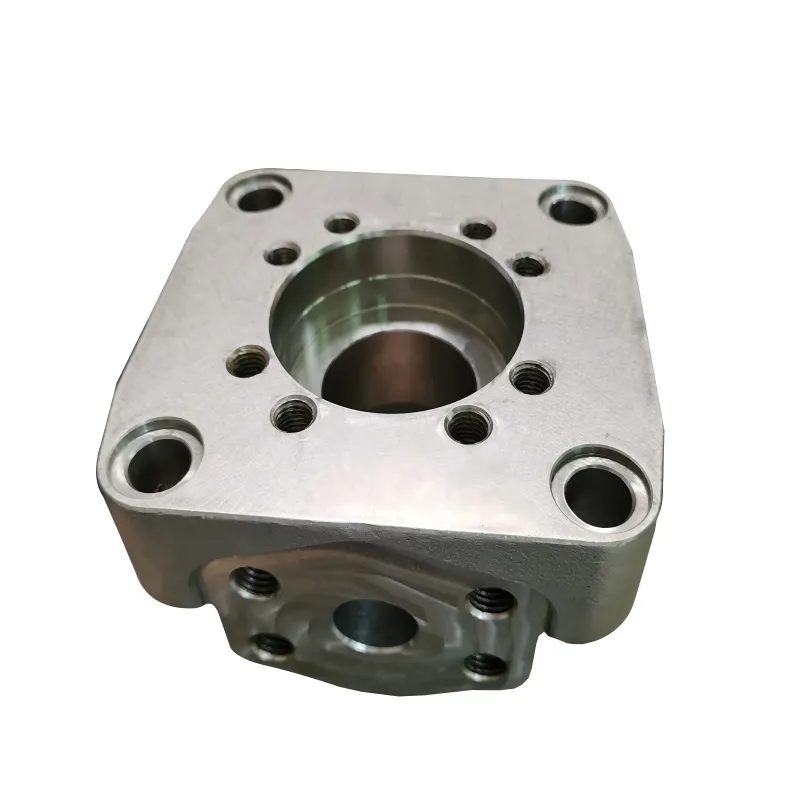
Here's a critical point often missed: no aerospace casting is truly 'net-shape'. Every critical interface—flange faces, bolt holes, sealing surfaces—requires post-cast CNC machining. The best aerospace investment casting companies integrate this capability seamlessly. The casting must be designed with machining datums in mind, and the foundry must understand how residual stress from casting affects machining distortion.
I recall a project for a turbine housing where the as-cast part passed inspection, but during machining, the thin-walled section distorted just enough to scrap the part. The issue? The gate and riser removal sequence induced localized stress. The solution came from the machining team working with the foundry metallurgists to redesign the casting's feeding system. This is why a company like QSY highlighting both investment casting and CNC machining under one roof is significant. It closes the feedback loop between casting design and final machined part, drastically reducing failure modes.
The machining of cast superalloys is another beast. They're often hard, abrasive, and prone to work hardening. Using the wrong tool path or coolant can induce micro-cracks into the surface, turning a structurally sound casting into a liability. An integrated supplier understands this holistically. They know how their own cast material behaves under their own machines.
Material Nuances: Not All Stainless Steel is Equal
Listing stainless steel as a material is almost meaningless in aerospace. Are we talking about 17-4PH for high strength? 316L for corrosion resistance? Or a proprietary martensitic grade for a specific landing gear component? Each has vastly different melting, pouring, and heat treatment characteristics. The real test for a foundry is in the special alloys: the nickel-based ones like Inconel 718 or 713C, which are the staples of hot-section components.
Casting these is a high-stakes game. They're expensive, they have narrow processing windows (the temperature range between solidus and liquidus is tight), and they demand precise heat treatment to achieve the required gamma prime precipitation. Any deviation in cooling rate can alter the mechanical properties. A foundry's capability is proven by its consistency with these materials over hundreds of pours. The mention of such alloys by a company like QSY directly signals engagement with more demanding applications, moving beyond generic structural parts.
Heat treatment is an entire sub-process. It's not just an oven cycle; it's a carefully controlled atmosphere (often vacuum or argon) to prevent surface oxidation (scaling) and decarburization. The furnace uniformity, the ramp rates, the quench medium—all are critical. A poor heat treat can ruin a perfectly cast part, and the flaws might only be detected in fatigue testing.
The Gating and Feeding Puzzle: Where Theory Meets Practice
CAD software can simulate mold filling and solidification, but the real world always adds wrinkles. Designing the gating and riser (feeder) system is the foundry engineer's core challenge. The goal is to achieve directional solidification, where the part solidifies first, feeding from the risers, to avoid shrinkage porosity. It sounds straightforward, but with complex, thin-walled aerospace geometries, it's a nightmare.
You often have to compromise. Adding more or larger risers improves soundness but increases metal yield (the ratio of final part weight to total metal poured), which for expensive superalloys blows the budget. It also creates more contact points for later removal, potentially affecting the surface. I've been in reviews where we went through a dozen iterations of gating design, sacrificing a bit of ideal weight for guaranteed structural integrity. The risers themselves must be designed to stay molten longer than the part, which involves calculations of modulus (volume-to-surface-area ratio).
This is pure, applied engineering judgment. A good foundry engineer can look at a cross-section and intuitively know where a hot spot will form and where porosity might hide. This judgment is built on years of cutting up sample castings (destructive testing) and comparing the internal structure to the simulation predictions.
Quality is an Ecosystem, Not a Department
Quality control in aerospace investment casting isn't a final inspection step; it's woven into every stage. It starts with incoming wax and ceramic material certs. Then it's process control: monitoring slurry tank temperatures, measuring shell thicknesses at each dip, recording pour temperatures and times. After casting, you move into NDT (Non-Destructive Testing): fluorescent penetrant inspection (FPI) for surface cracks, radiography (X-ray) for internal voids, and increasingly, CT scanning for complex internal passages.
The hard part is traceability. Every single part, from a small bracket to a large turbine case, must be traceable back to its melt heat number, its shell build batch, its pour lot, and its heat treatment batch. This creates an enormous amount of data. A failure in the field years later means you must be able to trace back and see if other parts from that same material or process batch are at risk. A company's ability to manage this data reliably is a huge part of its credibility.
Ultimately, the mark of a capable supplier isn't just making a good sample. It's delivering consistent, traceable quality at a viable production rate, year after year. It's about having the systems and the discipline to catch a drift in a process parameter before it produces a batch of scrap. That's what you're really looking for when you evaluate these companies—the depth of the system behind the shiny cast part.