When you hear 'colloidal silica investment casting', a lot of folks immediately think of the binder—just that milky liquid you mix into the slurry. That's the first place where the thinking often goes wrong. It's not just a glue; it's the entire structural backbone of the shell, and how you manage its chemistry and application dictates whether you get a flawless casting or a warehouse full of scrap. I've seen shops pour money into premium alloys only to lose it all on a poorly gelled shell that collapsed or veined. The real game is in the colloidal silica's particle size distribution, the pH stability, and frankly, the discipline of the process control, which many underestimate until they face a costly failure.
The Misunderstood Role of Colloidal Silica
Let's get specific. Colloidal silica isn't a single product. The stuff you get from different suppliers behaves differently. We learned this the hard way years back. We switched to a cheaper, off-brand colloidal silica for our shell mold casting process, assuming the specs on the sheet were close enough. The sodium content was slightly higher. The result? After the dewaxing stage, the primary coats developed micro-crazing. Not immediately obvious, but during the high-temperature burnout, those tiny cracks propagated. The final castings, particularly in complex stainless steel parts, showed consistent metal penetration. A total batch loss. That's when it clicked: the ionic stability and the Na2O content in the binder are non-negotiable parameters. It's not a commodity.
This ties directly into investment casting of special alloys like nickel-based ones. These alloys have high melting points and are incredibly reactive. If the shell isn't perfectly refractory and stable, you get metal-shell interaction—a nasty defect called slag inclusion or surface pitting. A high-purity, low-alkali colloidal silica is critical here. It forms a stronger, more refractory silica network after firing. I recall a project for a turbine component where we used a standard binder; the surface finish was unacceptable. Switching to a tailored, colloidal silica system with a tighter particle distribution solved it. The devil is in those details.
You see companies like Qingdao Qiangsenyuan Technology Co., Ltd. (QSY) with their three decades in shell mold and investment casting. They'd know this implicitly. When you're dealing with cobalt-based alloys day in and day out, you can't afford to treat the binder as an afterthought. Their long-term operation suggests a deep, practical understanding of these material interactions that you only gain from repeated production runs and problem-solving.
Process Control: Where Theory Meets the Shop Floor
Alright, so you've got a good binder. The next pitfall is the slurry room environment. Temperature and humidity control. It sounds basic, but I've been in foundries where this is an afterthought. Colloidal silica-based slurries are sensitive. If the shop is too hot, the slurry gels too fast, the viscosity spikes, and your coating thickness becomes inconsistent. Too humid, and the drying time between coats stretches out, killing your production rhythm. We had a summer where the AC failed in the slurry room. The entire production of investment casting shells for valve bodies had to be scrapped because the primer coat dried too fast, creating a weak interface with the subsequent stucco layers.
The dipping and stuccoing procedure is another art. The first coat is everything. It needs to perfectly replicate the wax pattern's detail. We use a very fine zircon flour blend with the colloidal silica for that first coat. But the wetting agent's concentration needs to be spot-on. Too little, and you get bubbles and voids on the pattern surface. Too much, and the slurry runs off, creating thin spots. This isn't something you set once and forget. The wax pattern material, its surface temperature, even the release agent used on the die, all affect it. It's a constant adjustment.
And drying. Forced air drying is common, but the airflow has to be laminar, not turbulent. You don't want dust from the floor (which is often full of previous stucco material) embedding itself into the wet coat. We built a simple positive-pressure booth for drying the initial coats, and the defect rate from inclusions dropped noticeably. These are the unglamorous, capital-intensive details that separate a reliable process from a chaotic one.
Case in Point: Shell Molds for Complex Geometries
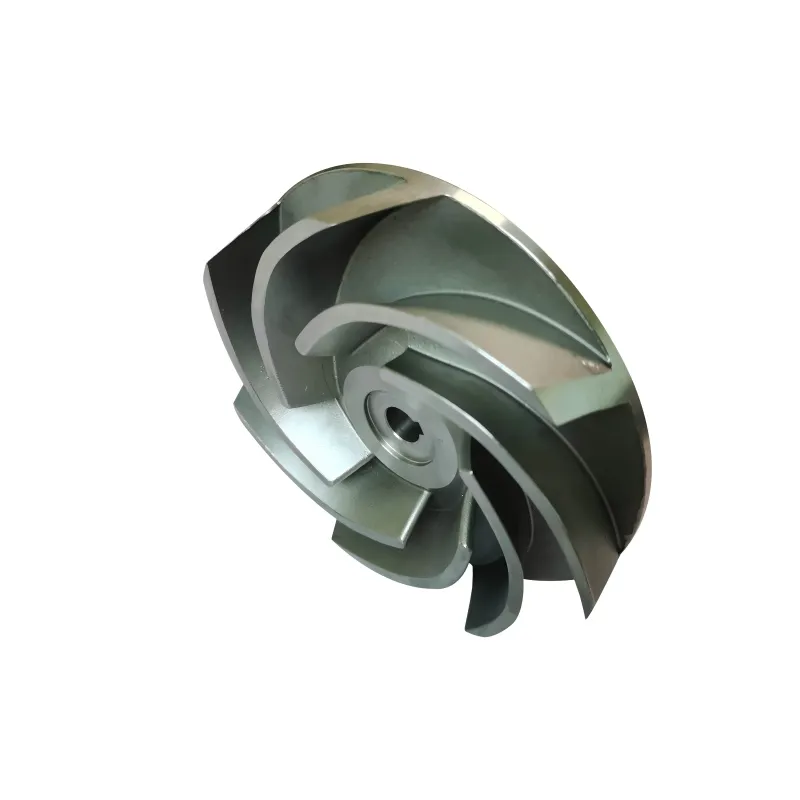
Take a complex impeller casting, thin blades, deep contours. The challenge isn't just making the shell strong enough; it's making it permeable enough to allow gases to escape during pour and burnout. This is where the colloidal silica binder's gel structure is key. If you over-stabilize the slurry to get long working time, you might compromise the gel's micro-porosity after firing. It becomes too dense.
We experimented with adding very fine, controlled amounts of a wetting agent and adjusting the gelling agent (usually an alkali salt) to fine-tune this. The goal was a shell that passed the standard strength tests but also had a higher gas permeability. The breakthrough came from not just looking at the binder data sheet, but from running our own permeability tests on fired shell samples. We correlated different slurry batches with actual casting results for steel components. The data was messy, but the trend was clear: a slightly lower viscosity slurry, applied in thinner primary coats, yielded a better fired structure for these intricate parts.
This kind of troubleshooting is the core of advanced shell mold casting. It's not textbook. It's about creating your own internal database of cause and effect. A company like QSY, specializing in both casting and CNC machining, likely has a tight feedback loop. They can machine a casting, see a subsurface defect from shell issues, and trace it back to a specific slurry batch or drying parameter. That integrated capability is powerful.
The Alloy Factor: Why Material Dictates Binder Choice
This brings me to the materials. Working with cast iron is one world; working with reactive superalloys is another. For nickel or cobalt-based alloys, the shell needs to be not just strong, but also chemically inert. High-alumina refractories are often used in the backup coats. But the binder—the colloidal silica—is the universal matrix holding it all together. Any impurity or instability here is a potential failure point at 1500°C+.
We once had a issue with mud cracking on large, flat surfaces of a stainless steel plate casting. The shell looked fine pre-pour. The problem was the thermal expansion mismatch between the colloidal silica gel and the refractory filler in the face coat. The binder itself was too hard after drying. The solution involved blending a small percentage of a different colloidal silica product with a modified particle morphology into our primary slurry. It created a more forgiving gel network that could accommodate thermal stress without cracking. This isn't a standard procedure. It was a fix born of necessity.
This level of material-specific adaptation is crucial. On the QSY website, they list their work with special alloys. Anyone in this field knows that statement implies a deep, hands-on library of process parameters for each material family. The colloidal silica system for a cobalt alloy will have nuances compared to the one for a standard carbon steel. It might be a different brand, a different blend, or a meticulously controlled set of slurry parameters.
Final Thoughts: It's a System, Not an Ingredient
So, wrapping this up, the key takeaway on colloidal silica investment casting is to stop viewing the colloidal silica as a mere purchased ingredient. It's the central component of a sensitive, interdependent system. The wax, the ambient conditions, the refractory flour, the stucco sand, the drying protocol, and finally, the alloy being poured—they all talk to the binder. The binder's behavior is the final common pathway.
The real expertise lies in interpreting the signals. A slight change in slurry drain time. A subtle difference in the gloss of a dried coat. A minor strength variation in a fired test piece. These are the things that tell you if your process is in control. It's empirical, sometimes frustratingly so. There's no single right answer, only a right answer for your specific shop, your equipment, and your product mix.
That's why longevity in this business, like the 30-year history of a firm such as QSY, is a credible signal. It means they've likely cycled through these problems, found their solutions, and stabilized their processes. For anyone getting into this, respect the colloidal silica process. Invest in measuring equipment for slurry parameters. Log everything. Be prepared to get your hands dirty and make adjustments. The difference between profit and loss is often in that milky white liquid and how you choose to manage it.