When you hear 'fundamentals of metal casting', most textbooks jump straight to the flow diagram: pattern, mold, pour, cool, finish. That's not wrong, but it's like describing driving by listing the car's parts. The real fundamentals live in the gaps between those steps—the heat haze over the ladle, the sound of metal filling the mold, the way a shell mold feels when it's just right. I've seen too many engineers fresh out of school fixate on the CAD model, forgetting that the metal has its own will. That's the first, and maybe biggest, misconception: casting is not just a manufacturing process; it's a negotiation with physics.
The Core Dance: Pattern, Mold, and Metal
Let's start with the pattern. It's the starting point, but its design is where you win or lose the job. Draft angles aren't just a number in a manual; a half-degree can mean the difference between a clean strip and a destroyed mold. We learned this the hard way on an early job for a pump housing, using a resin pattern. The design looked perfect on screen, but we didn't account for the resin's thermal expansion under the intense heat of the shell mold casting process. The result? A beautiful mold with terrible dimensional accuracy. The part was scrap. That failure taught me more about the fundamentals of metal casting than any textbook: every material in the chain, from pattern to final metal, expands and contracts. You have to know them all.
Which brings me to molds. At our shop, QINGDAO QIANGSENYUAN TECHNOLOGY CO.,LTD., we lean heavily on shell and investment casting. The choice isn't arbitrary. For high-volume, relatively simpler geometries in materials like cast iron or carbon steel, shell molding is incredibly efficient. The silica sand coated with phenolic resin gives you a mold with excellent surface finish and decent permeability. But the fundamental trick is in the curing. The mold needs just the right amount of time in the oven. Too little, and it's weak, risking a run-out during the pour. Too much, and it becomes brittle, potentially causing inclusions in the casting. You learn to judge it by the color and the smell—a very specific, slightly acrid scent of cured resin. It's not in any manual.
Investment casting, or lost-wax, is a different beast. It's for the complex stuff—turbine blades, intricate valve bodies. The fundamental here is control, absolute control, over every layer of the ceramic shell. A tiny bubble or a weak spot in the third coat will show up as a fin or a blister on the final stainless steel part. We use it extensively for our work with special alloys, like nickel-based ones. The thermal shock resistance of the ceramic shell has to perfectly match the pouring temperature of these superalloys. Get it wrong, and the shell cracks, metal leaks, and you have a very expensive, dangerous mess. It's a high-stakes process where the fundamentals are about patience and meticulous repetition.
The Pour: Where Theory Meets the Floor
This is the moment of truth. All the planning culminates here. The fundamentals of metal casting during the pour are about thermodynamics and fluid dynamics, but you're not solving equations; you're making split-second decisions. The metal temperature is critical. For ductile iron, we aim for about °C. But that's not a fixed number. If the molds are cold and damp on a humid day, you might go hotter to prevent premature freezing in thin sections. You watch the metal flow from the ladle—it should be a steady, bright stream, not a splatter. A turbulent pour introduces air and oxides, leading to defects.
Risers and gating systems are the unsung heroes. They're not just channels for metal; they're a pressure and feeding system. I recall a job for a thick-sectioned gear blank in steel. We placed the riser based on standard calculation. The casting solidified, and it looked perfect. Until machining. A massive shrinkage cavity was hidden right in the web. The riser had frozen before the thickest section, so it couldn't feed it. The fundamental we missed? Solidification modeling isn't just about volume; it's about direction and time. We now use simulation software as a guide, but we still cross-check with old rules of thumb—like making sure the riser's thermal mass is significantly greater than the section it's feeding.
Material is Everything (And Nothing)
People often think choosing a material is the first step. Sometimes it is, but often, the design dictates it, and you have to make it work. We handle everything from common cast iron to exotic cobalt-based alloys. The fundamental with materials is understanding their personality. Gray iron pours beautifully, is forgiving to machine, but hates impact. Ductile iron, with its nodular graphite, is tougher but more prone to shrinkage issues if not treated correctly right in the ladle.
Stainless steels, like 304 or 316, are a challenge because of their high melting point and tendency to form hard, brittle phases if the cooling rate isn't controlled. And the special alloys? That's top-tier work. Pouring a nickel-based alloy for a high-temperature application means controlling everything from the furnace atmosphere (to prevent oxidation of costly elements like chromium) to designing the gating to minimize turbulence that can erode the ceramic mold and contaminate the melt. The fundamental here is respect. You don't just pour these; you orchestrate their entire thermal history.
Beyond the Casting: The Machining Handshake
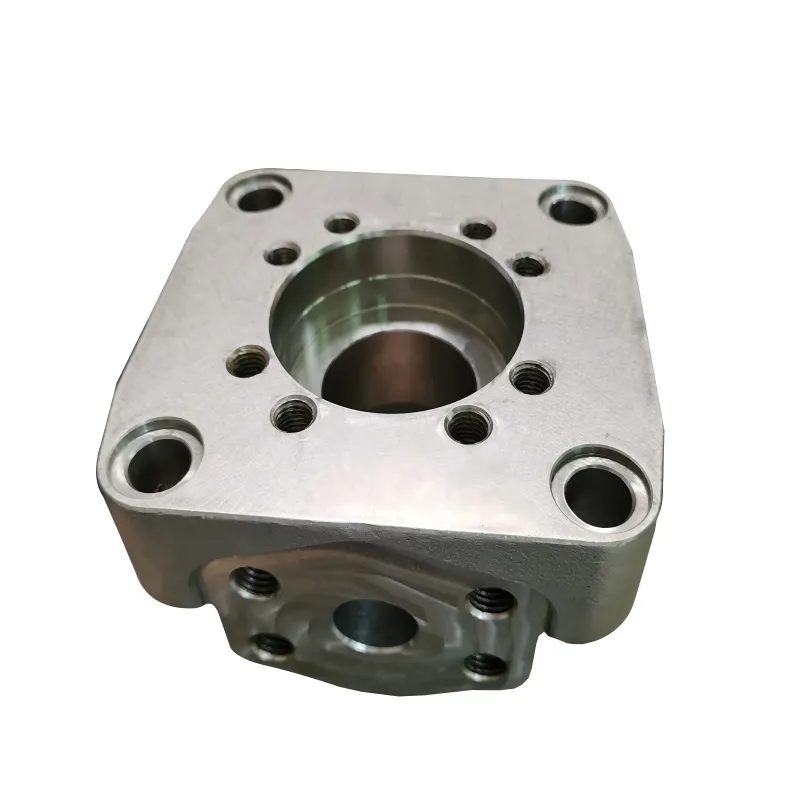
A casting is rarely a finished part. This is where the synergy at a place like QSY shows its value. Having CNC machining in-house isn't just a convenience; it's a fundamental feedback loop. The machinists tell us exactly where the casting is hard or soft, where there's unexpected porosity, or if our dimensional tolerances are holding up. We designed a bracket once where we left what we thought was ample machining stock. The CNC team came back and said the casting was distorting under the cutting force in one specific flange. The issue? Residual stress from uneven cooling. We adjusted the cooling protocol in the shakeout area, problem solved. The fundamental lesson: casting doesn't end at shakeout. The first cut of the machining tool is the ultimate quality test.
This integration shapes how we design patterns and molds. We know what our own machines can and cannot do, so we design castings with machinability baked in from the start. We might add a small datum pad on a non-critical surface just to give the CNC a reliable zero point. That's a practical fundamental you only learn by doing both sides of the work.
Failures Are the Real Textbooks
Let me end with a story that encapsulates the messy, non-linear reality of the fundamentals of metal casting. We had an order for a series of corrosion-resistant impellers in a duplex stainless steel. The geometry was complex, thin vanes, so we went with investment casting. The first few came out with what looked like tiny tears on the vane surfaces. Not cracks, but surface irregularities. We checked everything: wax injection parameters, ceramic slurry viscosity, dewaxing autoclave cycle. All were within spec.
The breakthrough came when an older foundryman, who'd been quietly watching, pointed at the dewaxing steam autoclave. You're boiling the wax out too fast, he said. The steam is hitting the cold shell, condensing, and the water is getting trapped in the lower parts of the mold before it can drain. When you pour the molten metal, that water flashes to steam instantly and blows a tiny hole in the ceramic face, which the metal then fills. It was a fundamental about phase change and condensation, not about casting per se. We slowed the steam ramp-up, allowed for better drainage, and the defects vanished. The real fundamental wasn't in the metal; it was in the water. And you won't find that unless you've stood on the floor, stumped, looking at a row of beautiful, defective parts. That's the heart of it all.