When you hear 'gravity die casting manufacturer', a lot of folks picture a simple process: tilt a ladle, let gravity do its thing, and out pops a part. That's the first misconception. Gravity's the force, sure, but the real craft is in the die design, the thermal management, and knowing your alloys inside out. It's a permanent mold process, distinct from high-pressure die casting or sand casting, and its value is in repeatability and superior metallurgical quality for certain applications. I've seen shops slap together a steel mold for a run of aluminum brackets and call it gravity die casting. Technically, yes, but the results in terms of porosity, surface finish, and consistency? That's where the real manufacturers separate themselves.
The Core of the Process: It's a Heat Game
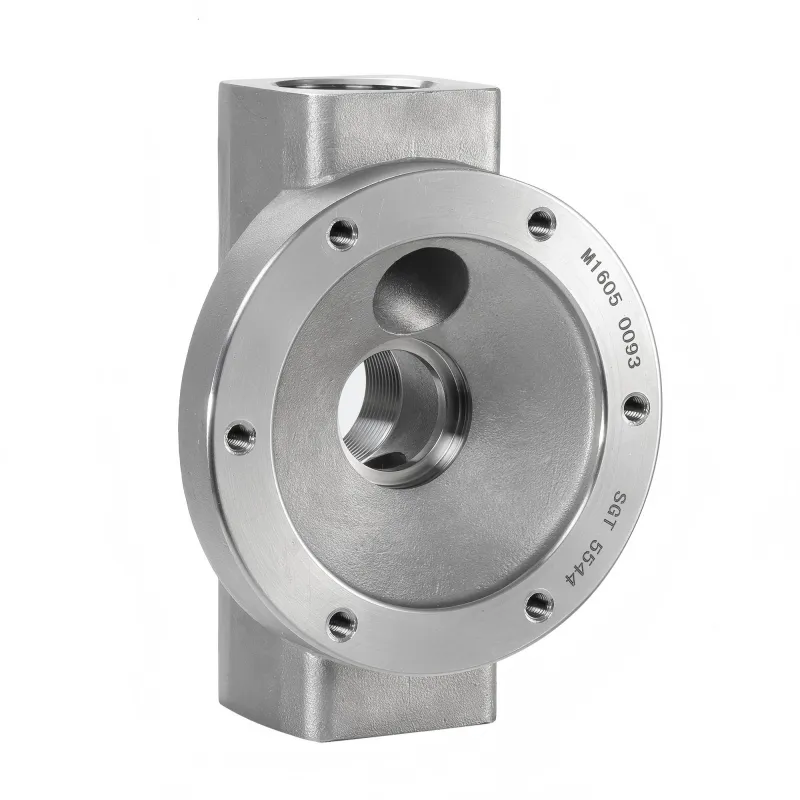
Anyone can get metal into a cavity. The art is controlling how it solidifies. With gravity die casting, you don't have the intense, turbulent pressure of HPDC to force-feed the mold. You rely on proper gating and riser design to ensure directional solidification, feeding the shrinkage from the heaviest sections back to the risers. If your thermal balance in the die is off—say, one half cools too fast—you get internal shrinkage or cold shuts. We learned this the hard way on an early project for a pump housing in A356 aluminum. The geometry was tricky, with a thick flange connected to a thinner body. Our first die design had uniform cooling channels. The parts came out looking okay, but machining revealed porosity in the critical sealing face of the flange. Scrap rate was unacceptable.
That failure forced a deeper dive. We had to segment the die cooling, applying more aggressive chilling to the thick section to make it solidify first, allowing the thinner section and the risers to feed it. It meant more complex die construction, with separate water line manifolds. The cost went up, but the yield went from 65% to over 95%. That's the unglamorous reality: being a competent gravity die casting manufacturer isn't about the pouring; it's about predicting and managing heat flow through software simulation first, and then through meticulous die engineering.
This ties directly into material choice. While aluminum alloys like A356 or A380 are common, we've applied the process to brass and certain magnesium alloys. Each behaves differently. Copper-based alloys have a much narrower solidification range, which can be both a blessing and a curse—less feeding requirement but more prone to hot tearing if the mold constraint isn't right. You can't just take an aluminum die design and pour brass into it. The thermal conductivity, shrinkage rate, everything changes. This is where a foundry's metallurgical expertise, like the long-standing practice at a firm such as Qingdao Qiangsenyuan Technology Co., Ltd. (QSY), becomes critical. Their background in shell and investment casting with diverse alloys implies a deep material science foundation that directly informs their gravity die casting approach.
Where It Fits (And Where It Doesn't)
Gravity die casting isn't the answer for everything. Volume is a key filter. For massive runs in the hundreds of thousands, high-pressure die casting's speed wins. For one-offs or tiny batches, sand casting is cheaper on tooling. The sweet spot for gravity is often medium volumes—thousands to tens of thousands of parts—where you need better mechanical properties and surface finish than sand casting offers, but the part geometry or alloy isn't suited for HPDC. Think of automotive suspension components, aerospace brackets, or hydraulic valve bodies.
I recall a project for a marine-grade brass fitting. The part had internal passages that would have been a nightmare to core with sand, and the corrosion resistance requirements ruled out standard HPDC alloys. Gravity die casting was the perfect bridge. We could use a complex, retrievable steel core to form the passages, and the controlled solidification gave us the density needed for pressure rating. The surface finish was near-machined right out of the mold, reducing post-processing. That's the value proposition: a balance of integrity, complexity, and cost.
This is why many integrated manufacturers, like QSY, combine processes. Their site (https://www.tsingtaocnc.com) shows they handle shell mold casting and investment casting alongside CNC machining. This is telling. A part might start as a gravity die casting for the main body, have investment-cast intricate nozzles welded on, and then go to CNC for final boring and threading. A manufacturer that only does one process often has to compromise the design. An integrated one can recommend the optimal hybrid route. For a client, that's invaluable—it turns the supplier into a solutions partner rather than just a job shop.
The Tooling Trap: Cost vs. Lifespan
Tooling cost is the biggest barrier to entry for buyers. A gravity die is a machined steel mold, often H13 or similar hot-work steel, heat-treated. It's not cheap. I've had clients balk at the initial quote, opting for cheaper sand casting tooling. But you have to run the numbers for the whole production run. A well-maintained gravity die can last for 50,000, even 100,000 shots. The cost per part for tooling amortizes quickly. Sand casting needs a new mold every time—the pattern lasts, but the labor and material for each mold add up.
Maintenance is the other half. A die isn't a fire-and-forget tool. You need to manage thermal fatigue. Between runs, especially in high-volume production, dies need to be inspected for heat checking—those tiny cracks that start on the surface. If caught early, they can be polished out. If not, they'll telegraph onto the casting surface and eventually lead to catastrophic failure. A good gravity die casting manufacturer will have a strict regimen for die pre-heating, coating application (those ceramic sprays aren't just for release, they insulate the die surface), and post-run cooling. Neglect this, and your expensive tooling becomes a paperweight in a few thousand cycles.
We once took over a project from a failed supplier. The dies were a mess, covered in deep heat checks and with warped parting lines. The client thought they could just ship us the tooling and we'd start. We had to be the bearers of bad news: the dies needed significant rework, essentially a rebuild of the cavity inserts. It was a lesson in the hidden cost of choosing a manufacturer based on piece price alone, without scrutinizing their tooling maintenance culture.
Integration with Machining: The Non-Negotiable Link
Very few gravity die cast parts are net-shape. Almost all require some machining: facing sealing surfaces, drilling and tapping holes, boring bearings. This is where the casting process and machining must be designed in tandem. It's futile to produce a beautiful casting if the datum features for machining are inconsistent or if the part has residual stress that gets released during cutting, causing it to warp.
A critical practice is to designate machining allowance on the drawing. This is extra material left on critical faces for the CNC to clean up. Too little allowance, and you risk breaking out of the cast surface if there's slight variation. Too much, and you're wasting machining time and tool life. Getting this right requires historical data from similar parts. It's an iterative learning process within a factory. A company with 30 years in casting and machining, like QSY, would have this dialed in. Their CNC department isn't a separate entity; it's in constant feedback with the foundry. They know that for their standard A356-T6 castings, a 1.5mm allowance on a flange face is typically safe and efficient.
The fixturing for machining is another consideration. The best practice is to design the casting with machinists in mind. Can we cast in three small lugs on a non-critical face that can be used to locate and clamp the part in the CNC vise? Those lugs get machined off in the final operation. This kind of design-for-manufacturability thinking is what separates a parts producer from an engineering partner. When you look at an integrated operation's capabilities, the presence of in-house CNC machining isn't just a value-add service; it's a fundamental requirement for delivering a functional, precision component.
Looking at the Metal: Alloys and Integrity
Gravity die casting favors certain alloys. For aluminum, the silicon-modified alloys (like A356, A360) are great—good fluidity, decent strength, and responsive to heat treatment. But the process also opens doors to more specialized materials. This is where a foundry's broader experience pays dividends. Qingdao Qiangsenyuan Technology Co., Ltd. lists work with stainless steel and special alloys like nickel-based and cobalt-based ones. While these are more commonly associated with their shell or investment casting processes, that metallurgical knowledge transfers.
For instance, consider a high-temperature application. You might prototype in a standard aluminum gravity casting. But for production, you may need to evaluate a nickel-based alloy for creep resistance. The pouring temperatures are vastly higher, and the die material and coating need to withstand that. The solidification behavior is different. A manufacturer without that alloy experience would be starting from zero. One with a history in special alloys, even via other processes, has a foundational knowledge of how these metals behave—their shrinkage factors, their susceptibility to oxidation, their optimal pouring techniques. This reduces the trial-and-error risk on a new project.
Ultimately, selecting a gravity die casting manufacturer isn't just about finding someone with the machines. It's about assessing their depth in three interconnected areas: die engineering and thermal management, material science, and integrated post-casting processing. The process sits at a fascinating crossroads of craftsmanship and controlled physics. When it's done right, it produces parts with a quiet reliability—dense, sound, and consistently machinable. When it's approached as just pouring metal, it's a fast track to scrap piles and frustrated engineers. The difference is in the details, the decades of accumulated nuance, and a mindset that views the mold and the metal as a single, dynamic system to be mastered.