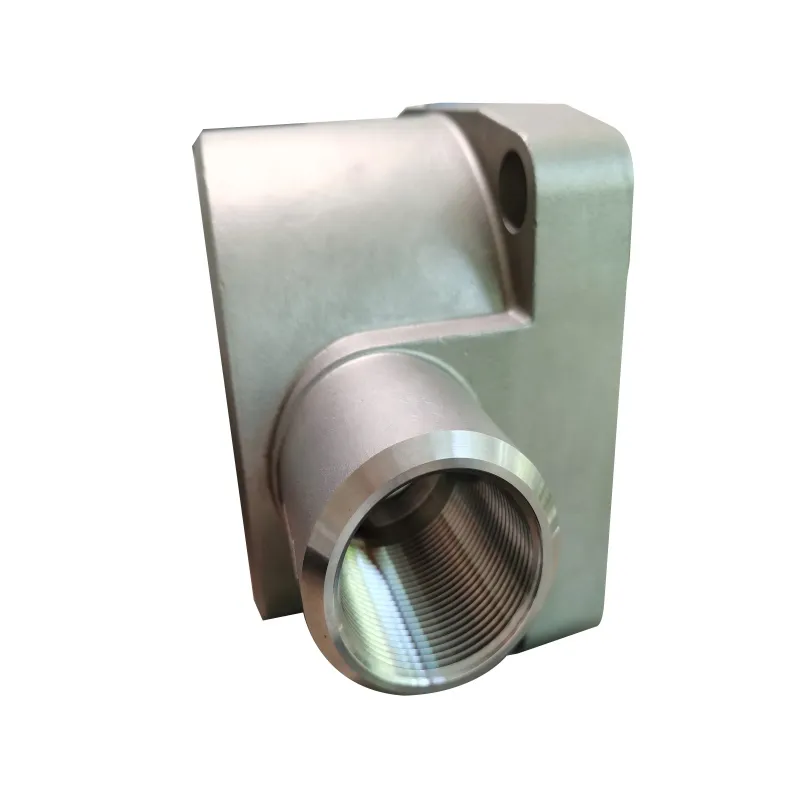
When someone says 'high quality investment casting', most minds jump straight to tolerance numbers and surface finish specs. That's part of it, sure, but if you've spent any real time on the foundry floor, you know that's where the conversation starts, not ends. The real quality is in the process decisions you make long before the metal hits the mold, decisions that aren't always captured in a neat PDF quote. It's the gating design you tweak based on last month's scrap, the shell drying time you adjust for the local humidity that week, or knowing which stainless grade actually behaves under rapid cooling for that thin-walled component. Too many buyers, and honestly some new engineers, treat it like a commodity service—send a 3D model, get a part. The gap between that and truly high quality is where everything interesting, and frustrating, happens.
The Foundation: It Starts Before the Wax
You can't talk quality without talking about the pattern. I've seen projects fail because this step was rushed. A perfect CAD model doesn't automatically translate to a perfect wax pattern. The injection parameters—temperature, pressure, cycle time—they need to be dialed in for the specific wax blend and the geometry of the part. A complex turbine blade with thin airfoils and a thick root section? You'll likely need different injection gates and cooling setups for different areas of the same die. If the wax pattern has internal stresses or slight distortions, those get baked into every subsequent step. I recall a job for a pump impeller where we kept getting slight warpage in the final casting. We chased our tails on the firing cycle for days before going back and realizing the wax injection temperature was just 5 degrees C too high, causing uneven shrinkage. That's the kind of root-cause digging that defines quality.
This is where experience with materials is non-negotiable. At a place like Qingdao Qiangsenyuan Technology Co., Ltd. (QSY), with their 30-year background, that pattern shop knowledge is institutional. They're not just pressing wax; they're anticipating how the wax for a nickel-based alloy turbine part will behave differently from the wax for a standard 316 stainless component during dewaxing. That foresight is a silent but critical component of high quality investment casting.
And the wax assembly, or treeing, is an art form. How you orient the patterns on the central sprue directly impacts the fill dynamics and solidification. You want to minimize turbulence and ensure directional solidification toward the feeder. It looks simple—just welding wax sticks—but the angle and placement are deliberate. A poorly designed tree is a recipe for isolated shrinkage pockets, no matter how good your shell is.
The Shell: Where Consistency is King
The ceramic shell is the literal mold, and its integrity is everything. The multi-layer dip-coat process seems straightforward: prime slurry, stucco, dry, repeat. But the devil is in a thousand details. The viscosity of the slurry needs constant monitoring and adjustment—it changes with temperature and as material evaporates. The stucco sand grain size distribution for each coat (usually finer for the face coats, coarser for the backup coats) must be controlled to build strength while allowing gas permeability.
The drying environment is a major variable often underestimated. I've worked in facilities where seasonal humidity swings would wreck shell drying schedules, leading to cracks or low green strength. A truly controlled drying room, with consistent temperature and dehumidification, isn't a luxury; it's a baseline for high quality investment casting. Without it, you're gambling. The shell needs to be strong enough to survive dewaxing and handling, but porous enough to let air escape during the pour. Getting that balance right is a practiced, tactile skill—the technicians know by the sound and feel of the shell when it's ready.
Dewaxing itself is a critical shock point. Most use steam autoclaves now. The rapid heating melts the wax out, but if done too aggressively, it can crack the shell from thermal stress. The pressure and cycle time profiles are developed over years. A crack here might be microscopic, but it will show up as a fin or flash on the final casting, requiring extra finishing work or causing rejection.
Melting & Pouring: The Point of No Return
This is where all the prep work gets tested. For high-performance alloys like the cobalt-based alloys or super duplex stainless steels that QSY lists, melt practice is paramount. It's not just about reaching the liquidus temperature. It's about holding time, slag control, and effective degassing to minimize porosity. You need the right furnace atmosphere (often argon or vacuum for reactive alloys) to prevent oxidation and inclusion formation.
The pour is a brief, decisive moment. The metal must be at the correct superheat—hot enough to fill the entire mold, especially thin sections, but not so hot that it causes excessive metal-shell reaction or grain growth. The pour must be smooth and continuous to avoid turbulence that traps air. I remember a case with a complex manifold where we had persistent porosity in a specific junction. We tried adjusting the gating, the shell, everything. Finally, we slowed down the pour rate by about 20%. It turned out the faster pour was creating a vortex in that cavity, sucking in air. A slower, steadier stream solved it. Sometimes the fix isn't high-tech; it's just observation and patience.
Solidification is the final act of the casting process. The mold design (the gates and feeders we built hours or days earlier) now has to work. The metal must solidify directionally, from the farthest point back toward the feeder, which acts as a reservoir of liquid metal to feed shrinkage. If this doesn't happen, you get shrinkage porosity inside the casting wall. Computer simulation helps nowadays, but there's no substitute for cutting up a first-article casting to verify the solidification pattern. It's a destructive test, but it's the only way to be sure your process is sound.
Finishing & Validation: The Unseen Work
Once you shake out the casting, the real mettle of a foundry shows. A high quality investment casting should require minimal finishing. But minimal is key. The gate and feeder connections need to be cut off, usually with a high-speed saw or abrasive wheel. Then there's grinding, blending, and shot blasting. The skill here is to remove the excess material without damaging the part or leaving stress concentrations. For a critical aerospace bracket, an aggressive grind could create a micro-crack initiation site.
This is where integration with CNC machining becomes a huge advantage, something QSY's combined casting and machining setup highlights. Having machining in-house means the finishing team understands which surfaces are critical datums for later machining. They might leave extra stock (positive tolerance) in those specific areas while cleaning up non-critical surfaces to net shape. It's a coordinated approach that prevents over-grinding a surface that a machinist will later need to cut.
Validation is layered. Dimensional checks with CMMs for critical features, dye penetrant testing for surface defects, X-ray or UT for internal integrity. For high-integrity parts, you're often doing all of the above. The paperwork trail—the melt report, the inspection records—is as much a part of the quality as the physical part. It's proof of control. A foundry that can't provide a coherent data package probably didn't have a coherent process.
The Real Measure: Solving Problems, Not Just Making Parts
So, what separates a good investment casting supplier from a great one? It's not the brochure. It's how they react when something goes off-script. A new alloy behaves unpredictably. A design has an inherent hot spot. The quality of a foundry is revealed in their problem-solving loop. Do they just blame the wax or the metal batch? Or do they have the engineering depth to run a small DOE, adjust the tree layout, modify a slurry formula, and get back to you with a solution and data?
That's the value of a partner with deep operational history. When Qingdao Qiangsenyuan Technology Co., Ltd. talks about three decades in shell mold casting and investment casting, that time represents a library of solved problems. They've likely seen a version of your challenge before. That institutional memory prevents costly re-learning and trial-and-error on your dime.
Ultimately, high quality investment casting is a chain of a hundred small, well-considered steps. It's a craft supported by science. It's about controlling variables you can control (like slurry viscosity and pour temperature) and understanding how to manage the ones you can't fully eliminate (like ambient humidity). The goal isn't perfection—that's impossible in a process with so many thermal and material variables—but it's about relentless consistency and intelligent intervention. The final part that meets spec, machines well, and performs in the field? That's just the output. The quality was built in hours, days, and years before it ever left the foundry.