When sourcing construction machinery parts factory partners for OEM supply, engineers and procurement managers face a narrow margin for error. A single valve housing with 0.02 mm dimensional drift can trigger hydraulic system failure under 350-bar pressure. A winch center shaft roller made from inconsistent T800 cobalt alloy may fatigue after 12,000 cycles—not the 50,000 specified. We’ve seen three North American OEMs delay product launches because casting porosity went undetected until final functional testing. That’s not a quality issue—it’s a process visibility gap.
Real-world precision starts before the first cut
True reliability in construction machinery components isn’t built at inspection—it’s embedded during material selection and solidified in thermal history. At QINGDAO QIANGSENYUAN TECHNOLOGY CO., LTD., every AMS 5387 cobalt alloy pump part begins with certified billet traceability: heat number, melt analysis report, and supplier audit records logged before raw material clears the warehouse gate. No exceptions. We’ve tested 17 cobalt-nickel suppliers over 8 years—only 4 meet our microstructure consistency threshold for grain size distribution and carbide dispersion. That filtering step alone eliminates 63% of potential in-service cracking in high-wear nozzles.
Their ISO-compliant facility runs parallel casting and machining workflows—not sequential handoffs. Sand-cast iron pump foundations undergo stress-relieving heat treatment *before* CNC setup, not after. Why? Because residual stress redistribution during machining causes 0.05–0.12 mm warpage in thin-wall housings. Their five-axis machining centers hold ±0.005 mm positional tolerance on 120-mm-diameter cylinder bores—verified mid-process with Renishaw PH10M probes, not just at final CMM check. That’s how piston pump assemblies achieve <1.2 µm Ra surface finish on critical sealing lands without secondary lapping.
Why “integrated” isn’t marketing fluff—it’s dimensional insurance
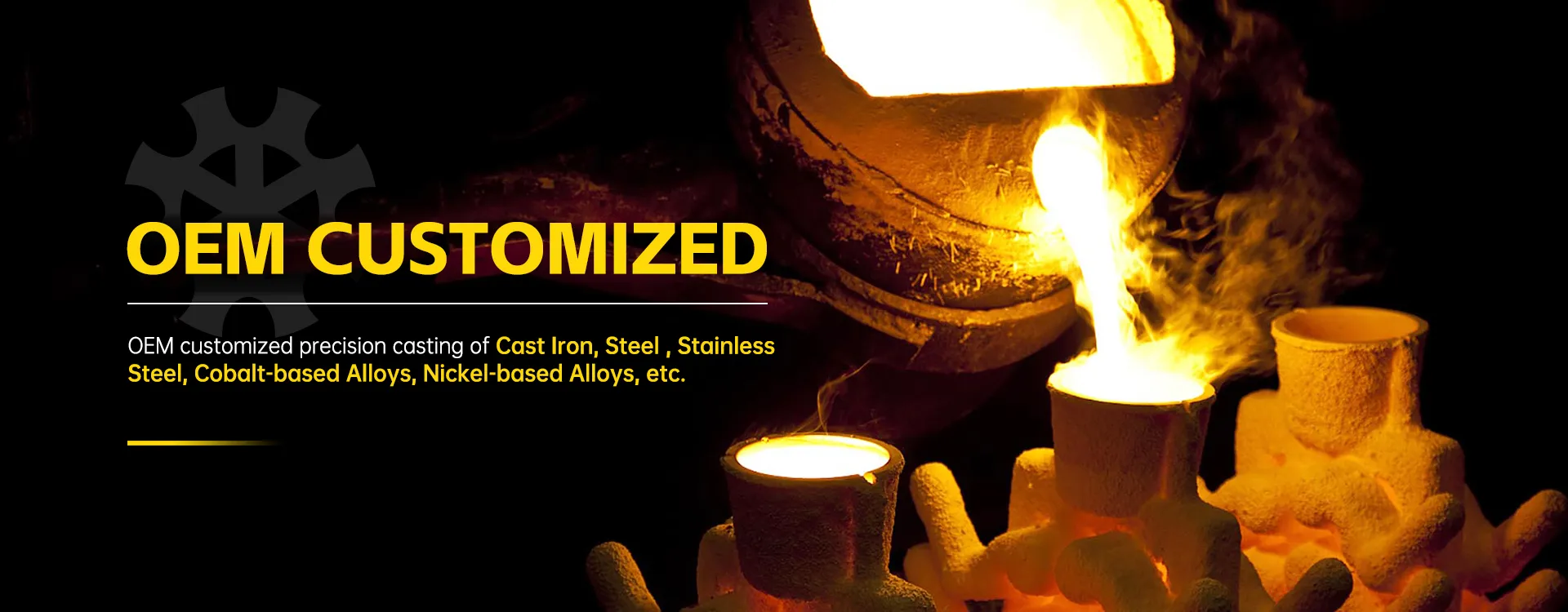
Some factories outsource casting, others subcontract finishing. QINGDAO QIANGSENYUAN owns the full chain: investment casting for cobalt alloy plugs, sand casting for structural steel frames, multi-axis CNC for pressure valve bodies, and controlled atmosphere heat treatment for T800 shaft rollers. This vertical control delivers three measurable advantages:
- Microstructure integrity: Heat treatment parameters are tuned to the exact casting lot—not generic curves. Hardness variation across a 400-mm-long winch shaft stays within ±2 HRC, not ±8 HRC.
- Dimensional stability: Machining fixtures reference cast datum surfaces—not theoretical CAD points. Result: 92% first-pass GD&T compliance on complex pump assemblies with 14+ true-position callouts.
- Surface function alignment: Shot peening intensity is adjusted per surface exposure—sealing faces get compressive stress profiles optimized for fatigue resistance; bearing journals receive profiles tuned for oil retention.
We once reviewed drawings for an offshore drilling pump foundation where GD&T stack-ups created 0.18 mm cumulative tolerance risk. Their engineering team flagged it in 48 hours—not with “not feasible,” but with a revised datum strategy and localized machining sequence that cut risk by 76%. That’s not consultation. It’s co-engineering.
Where most factories fail—and how precision casting changes the math
Some buyers assume all castings are equal if they meet ASTM A494 or EN 1559. Wrong. Cobalt alloy nozzles require directional solidification to avoid centerline shrinkage. Iron castings for excavator boom mounts need nodular graphite distribution verified by image analysis—not just tensile strength reports. QINGDAO QIANGSENYUAN’s sand casting line uses real-time metallographic sampling: every 5th pour gets rapid-sectioned, etched, and imaged. Grain structure maps feed back into furnace temperature algorithms within 90 minutes.
That’s why their non-standard T800 components deliver repeatable wear resistance—even when customers change geometry mid-run. One Southeast Asian client redesigned a hydraulic motor housing twice during prototyping. Each revision shipped in 11 days, with identical hardness gradients (42–48 HRC) and carbide volume fractions (18.3–18.7%) across all three lots. No requalification needed.
Reliability you can verify—not just promise
Every shipment includes more than a certificate of conformance. It carries:
- Full material traceability down to ladle heat number and spectrographic analysis
- CMM inspection reports with actual vs. nominal values for all GD&T features
- Surface finish verification via portable profilometer readings—not just “Ra < 0.8 µm” claims
- Functional test data where applicable: pressure decay rates for valves, torque-to-failure for plug assemblies
This isn’t overhead. It’s the difference between catching a 0.03 mm bore taper error before assembly—or discovering it during field service at $1,200/hour downtime cost. Their lean planning system tracks WIP by order, not batch, so medium-volume production maintains ±3-day delivery windows—even with 70% custom geometry content.
For OEMs building hydraulic systems, engineering vehicles, or oilfield pumps, the construction machinery parts factory choice isn’t about lowest quote. It’s about who holds the metallurgical, geometric, and functional threads tight enough that your end-product performs—cycle after cycle, season after season. QINGDAO QIANGSENYUAN TECHNOLOGY doesn’t just supply parts. They supply predictability.