When people hear 'investment casting aerospace', they often picture flawless, gleaming turbine blades fresh off the promotional video. The reality is far messier, more constrained, and frankly, more interesting. It's not just about achieving complex geometries; it's a constant negotiation between design ambition, metallurgical reality, and the brutal economics of volume, scrap rates, and lead times. Many assume tighter tolerances are always better, but specifying a ±0.05mm on a non-critical internal surface can triple the cost for zero functional benefit. That's where the real work happens.
The Core Misconception: It's Just a Precise Process
The biggest oversimplification is treating investment casting as merely a precision alternative to forging or machining. Precision is an outcome, not a given. It's earned through control of a hundred variables. For instance, the wax pattern injection parameters—temperature, pressure, dwell time—directly affect dimensional stability and surface finish long before any metal is poured. A minor fluctuation in the wax room's ambient temperature can introduce stress patterns that only reveal themselves as thin-wall distortion after shell building and dewaxing. You're not just casting metal; you're casting the entire history of the wax and ceramic process.
I recall a project for a structural bracket in a nickel-based superalloy. The design was pushing the limits on thin walls and sharp internal corners. The simulation looked clean. First articles, however, showed persistent micro-tears at the junctions. The immediate reaction from engineering was to tweak the gating. But the root cause was more fundamental: the specific alumina-silicate binder in the primary slurry layer was creating an unfavorable thermal gradient against that particular alloy's solidification characteristics. Switching to a zircon-based facing material, despite its higher cost, resolved it. The lesson? The shell in shell mold casting isn't a passive container; it's an active thermal system.
This is why long-term partnerships with foundries that have deep material-specific experience are invaluable. A company like Qingdao Qiangsenyuan Technology Co., Ltd. (QSY), with their three decades in investment casting and machining, would have faced these scenarios countless times. Their experience across cast iron, steel, and critical cobalt-based alloys and nickel-based alloys means they've likely built an intuitive library of which shell recipes work with which families of metal under different geometric stresses. That tacit knowledge isn't in any software package.
The Material Dance: Alloys Are Not Interchangeable
Speaking of alloys, the aerospace shift towards materials like Inconel 718, Mar-M247, or cobalt-based HS-188 isn't just a spec sheet change. Each behaves like a different animal during the investment casting process. 718 is relatively forgiving but prone to segregation if the pour temperature is off by a hair. The vacuum melt for a directionally solidified Mar-M part is a ballet of temperature control and withdrawal speed. Get it wrong, and you don't just get a reject; you get a costly furnace clean-out.
We learned this painfully on an early project for a combustor swirl cup. The print called for a proprietary cobalt alloy. We sourced what we thought was an equivalent grade. The chemistry was within spec, but the trace element differences—things like lanthanum or yttrium content—drastically altered the fluidity and hot-tear resistance. The result was a 40% scrap rate on the first production run due to cracking. The fix wasn't a process tweak; it was going back to the mill for a melt with a tighter, more tailored trace element profile. Now, I'm hyper-aware that an alloy spec is a starting point, not a guarantee.
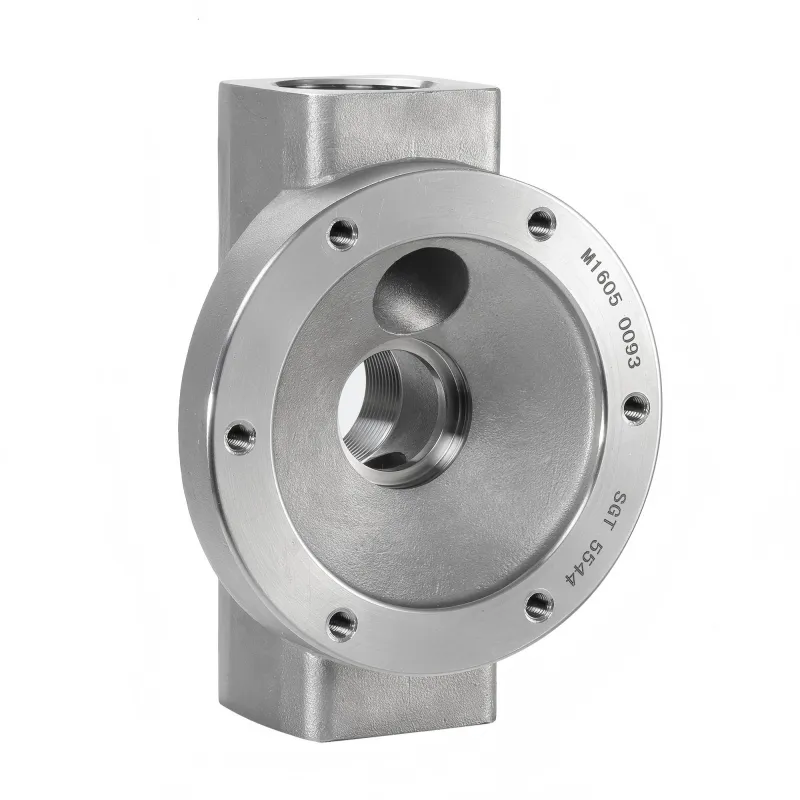
This is where integrated facilities show their strength. When the same entity handles the investment casting and subsequent CNC machining, they can make informed trade-offs. Maybe they leave an extra 0.5mm of stock on a tricky flange knowing their machining team has a specific fixture strategy, optimizing the casting process for integrity rather than near-net-shape perfection. A look at QSY's capabilities (https://www.tsingtaocnc.com) suggests this integrated approach—casting and machining under one roof—which is critical for aerospace parts where post-cast machining is almost always required to hit those final datum features.
The Gating and Feeding Puzzle: More Art Than Science
Simulation software has come a long way, but gating design remains part science, part black art. The software can predict shrinkage porosity, but it can't fully account for the interaction between the ceramic shell's thermal mass and the alloy's freezing range in real-world furnace conditions. I've seen beautifully simulated feed paths fail because they created a hot spot in the shell, delaying solidification in the wrong place.
A practical example: a large, thin-walled titanium housing. The simulation suggested a simple top-gate with multiple feeders. The first pour resulted in cold shuts and laminations. The issue? Titanium's rapid cooling and viscosity. The gating was creating turbulent, cooling metal before it fully filled the cavity. The solution, developed through literal trial and error, was a combination of smaller, distributed gates and a slightly higher superheat, coupled with a pre-heated mold to slow the initial chill. It was counter-intuitive to the standard practice for aluminum or steel.
This iterative, empirical problem-solving is the heart of complex investment casting. You start with simulation, but you must be prepared to physically iterate. A supplier's willingness and ability to run these small-scale trials—often at their own cost to build a relationship—is a key differentiator. It's not just about having the shell mold casting equipment; it's about having the patience and expertise to debug the process for your specific part.
The Inevitable Handoff: Casting to Machining
No aerospace casting is truly as-cast. There's always machining, often EDM, sometimes welding or brazing. The handoff here is a major source of finger-pointing. The machinist blames the caster for hard spots, residual stress, or hidden porosity. The caster blames the machinist for improper clamping or aggressive cuts.
The most successful projects I've managed treated the cast part as a pre-form. We held joint reviews between the foundry and the machine shop before the first pattern was even cut. Questions like: Can we add a small pad here for a machining datum? Is this wall thickness sufficient for your chucking pressure? Should we stress-relieve before or after rough machining for this alloy? These conversations are gold. They align expectations and turn a serial process into a parallel one.
This is the implicit value proposition of a full-service provider. When QSY mentions their combined expertise in investment casting and CNC machining, it signals they've presumably internalized these conversations. They can optimize the casting to be machinable, knowing exactly what their own machining department needs. It eliminates a huge layer of risk and communication overhead, which for an aerospace program, is often more valuable than a slight per-unit cost saving from a disjointed supply chain.
Looking Ahead: Not Just Complexity, but Consistency
The future of investment casting aerospace isn't necessarily about more baffling geometries; additive manufacturing is taking the extreme complexity crown. The value of investment casting will solidify (pun intended) in high-volume, high-reliability components where consistency across thousands of parts is paramount. Think fuel system components, actuator housings, brackets—parts that may look simple but have zero tolerance for internal defects.
The challenge shifts from can we make it? to can we make ten thousand of them identically, with a scrap rate below 0.1%? This demands a different kind of sophistication: statistical process control on wax dimensions, automated shell dipping robots for uniform coating, and real-time melt chemistry analysis. It's less about artisan skill and more about industrialized, data-driven repetition.
Suppliers who survive this shift will be those who invested not just in newer furnaces, but in the digital backbone to track and control every parameter. It's the boring, unsexy work of quality management that will define the next generation of aerospace foundries. The ones who get it will be quoting not just on price and capability, but on a proven statistical process capability (Cpk) for the specific feature you care about. That's the real frontier now.