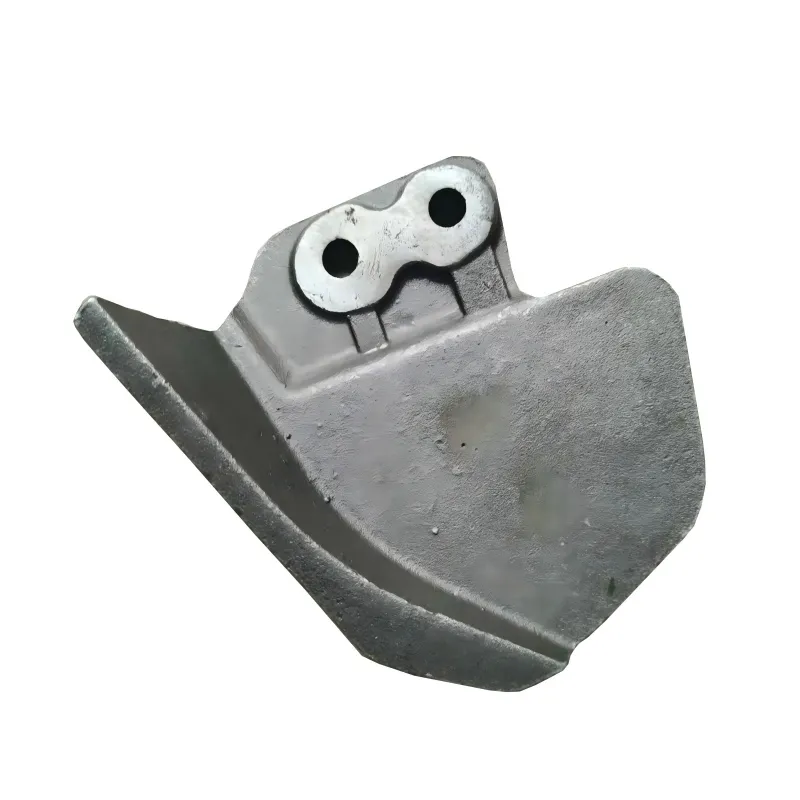
When you hear 'precision investment casting manufacturer,' most minds jump straight to tight tolerances and complex geometries. That's correct, but it's also where the first major pitfall lies. The real challenge isn't just achieving the numbers on a drawing; it's maintaining them consistently across a production run while managing variables most clients never see—like wax blend viscosity from batch to batch, or how local humidity on a Tuesday afternoon might affect the ceramic shell's drying rate. Many buyers shop based on a listed capability, say, ±0.005 inches, without asking about the process control framework that actually delivers it. That's where the real separation between job shops and true manufacturers happens.
The Foundation: It Starts Before the Wax
You can't talk about precision without talking about the pattern. A lot of newcomers to the field assume the magic happens in the furnace. In my experience, over 60% of potential dimensional errors are locked in at the tooling and wax injection stage. If the mold isn't right, you're just replicating imperfection with high fidelity. I've seen projects where the client provided a beautiful, machined aluminum master pattern, but didn't account for the dual shrinkage—first of the wax, then of the metal. We had to build that cumulative shrinkage right into our tooling design. It's a conversation about coefficients, not just copying a shape.
This is where a long operational history matters. A company like Qingdao Qiangsenyuan Technology Co., Ltd. (QSY), with their 30 years in casting and machining, has likely built and iterated on thousands of these tools. That database of material behaviors—how a specific stainless steel grade shrinks versus a nickel-based alloy—isn't something you find in a textbook. It's etched into their process sheets. Visiting their facility at tsingtaocnc.com, you get a sense of that depth; it's in the organized racks of well-maintained molds, not just the shiny new machines.
The wax room itself is a climate-controlled ecosystem. The temperature needs to be stable, not just 'comfortable.' A fluctuation of a few degrees can change the flow characteristics, leading to minor variations in wall thickness that only show up after metal pour. We learned this the hard way on an early aerospace order for sensor housings. The parts passed initial inspection, but failed in a later assembly stage due to inconsistent internal rib thickness. The root cause? An undetected draft in the workshop door was causing a subtle temperature gradient near the injection press. It was a humbling, expensive lesson in environmental control.
The Shell: Where Chemistry Meets Craft
The ceramic shell building process is often described as a science. It is, but there's a significant craft element in the slurry room. The composition of the primary slurry coat is critical for surface finish, but the stucco application—how those coarse, refractory grains are applied—affects shell permeability and strength. Too aggressive, and you embed stresses; too gentle, and you get weak spots. It's a tactile skill the operators develop over years.
Drying time between coats is another critical, and often underestimated, factor. Rushing it to meet a schedule is a surefire way to introduce shell cracks or delamination. These flaws might not cause an outright scrapped part, but can lead to surface fins or micro-roughness that kills the 'precision' in post-machining. I recall a batch for a hydraulic valve body where we faced mysterious surface pitting. After ruling out metal quality, we traced it back to a new technician who was stacking dipped patterns too close together in the drying room, hindering airflow and trapping moisture within the shell layers.
For alloys like cobalt-based or nickel-based ones that QSY lists, which are often poured at extremely high temperatures, the shell's thermal shock resistance is paramount. The formulation here might differ from that used for standard cast iron. It might include specific zirconia blends. This isn't a one-shell-fits-all operation; the material dictates the process.
Pouring & Solidification: The Moment of Truth
This is where all the prep work gets tested. Precision investment casting's advantage is directional solidification—controlling how the metal cools to minimize shrinkage porosity. It's not just about heating the metal and pouring it in; it's about pre-heating the shell to a specific temperature (which varies by alloy), controlling the pour speed, and sometimes even using chills—metallic inserts in the mold—to force heat extraction in a specific sequence.
Getting this wrong with a high-value alloy is a costly mistake. We once processed a run of turbine blades from a proprietary nickel alloy. The metallurgy was sound, the shell looked perfect, but we had a 40% scrap rate from internal micro-porosity. The issue? The shell pre-heat temperature was about 50°C too low for that particular alloy's optimal fluidity and feeding characteristics. The metal was freezing too quickly, not allowing the risers to feed the casting properly. The fix was a simple temperature adjustment, but diagnosing it required slicing parts, doing metallographic analysis, and a lot of head-scratching.
This phase highlights why integrated CNC machining capability is such a logical, almost necessary, extension for a serious investment casting manufacturer. At QSY, having machining in-house isn't just for adding threads or finishing a face. It allows for a feedback loop. The machinist who encounters a hard spot or unexpected porosity in a specific zone of a casting can walk directly back to the foundry floor. That immediate communication helps pinpoint whether it was a gating issue, a localized shell weakness, or something in the melt. It closes the quality loop.
Post-Cast: The Deceptively Simple Steps
Knock-out, cut-off, and heat treatment. These sound like brute-force steps after the finesse of shell-building and pouring, but they're delicate in their own right. Vibratory shell removal has to be forceful enough to break the ceramic but not so aggressive it damages thin sections of the now-solid metal. I've seen beautiful, intricate castings get cracked by an over-enthusiastic knock-out process.
Heat treatment is its own specialty, especially with the advanced materials. A standard stainless steel might need a simple stress relief. A precipitation-hardening stainless or a tool steel requires a very specific cycle of heating, soaking, and cooling to achieve the specified mechanical properties. If the casting is to be a functional component bearing load, this step is as critical as the casting itself. It's another area where decades of experience, like QSY's three decades, pay off—they've likely established and validated heat treat protocols for a vast matrix of alloy specs.
This is also the stage where initial inspection happens. First article inspection is exhaustive, often involving CMM (Coordinate Measuring Machine) to verify every critical dimension against the 3D model. But the real test is in-process inspection during production. How do you sample? What's your AQL (Acceptable Quality Level)? A manufacturer worth its salt will have a clear, statistically grounded plan, not just a promise to 'check a few.'
The Real Precision: Consistency & Communication
So, what truly defines a precision investment casting manufacturer? It's not the single, perfect prototype part. It's the ability to deliver the 500th part in a run that is indistinguishable from the 1st and the 50th. That consistency is the product of controlled, documented, and deeply understood processes at every single stage—from wax to final inspection.
The other half is communication. The best projects I've been involved in featured an open dialogue with the client's engineers. Sometimes, a slight design tweak—adding a radius, adjusting a wall thickness gradient—can make a part dramatically more castable without affecting its function, thereby improving yield and reliability. A manufacturer acting purely as an order-taker won't offer that. One that's a partner will. Looking at QSY's integrated model of shell mold casting, investment casting, and machining, it suggests they're structured to have that holistic view of part manufacturing, capable of advising on the best route from concept to finished component.
In the end, precision is a culture, not a machine setting. It's the operator who notices the wax looks slightly different today, the metallurgist who questions a heat treat chart, and the quality manager who insists on a root-cause analysis for a single outlier. When you're evaluating a manufacturer, look beyond the brochure's capability list. Ask about their process control points, their failure analysis procedures, and how their foundry and machine shop talk to each other. That's where you'll find the real precision.