When you hear 'precision lost wax investment casting', most think it's just about making intricate shapes. That's the surface. The real story is in the fight for dimensional fidelity, the battle against ceramic shell distortion, and the constant negotiation between alloy behavior and thermal stress. It's not magic; it's a chain of controlled compromises.
The Shell Game: Where Precision is Won or Lost
Everyone obsesses over the wax pattern, and sure, a good injection is the start. But the shell building? That's the silent determinant. I've seen shops pour money into high-resolution 3D printed patterns only to lose all that edge definition in the first dip coat. The slurry viscosity, the stucco grain size and morphology—get this wrong, and you bake in distortion from day one. The shell isn't just a mold; it's a structural corset during pour and a barrier during cooling. If its thermal expansion doesn't have a somewhat predictable relationship with your metal, you're chasing your tail on tolerances.
Take a common pitfall: assuming a thicker shell is always better for dimensional stability. For a heavy-section steel casting, maybe. But for a thin-walled aerospace component in a nickel-based superalloy, a overly rigid shell can induce hot tearing as it restricts contraction. You need a shell strong enough to hold the metal, but with enough 'give' at the right temperature. That's where the proprietary binder systems and layered stucco application from experienced foundries make the difference. It's feel and experience, not just a spec sheet.
I recall a project for a turbine sensor housing, where the spec called for a ±0.1mm tolerance on an internal bore. The wax was perfect. We used a standard zirconia face coat. First pours consistently came in at +0.15mm. The issue? The face coat was too reactive with the superalloy, creating a slightly thicker-than-expected reaction layer that effectively altered the cavity size. We switched to a fused silica-based prime slurry—less reaction, more inert barrier—and got back into tolerance. The precision lost wax investment casting process is full of these micro-interactions.
Alloy Behavior: The Unpredictable Partner
Speaking of alloys, this is where generic knowledge fails. Precision investment casting of 304 stainless is a world apart from doing it with a cobalt-based alloy like Stellite 6 or a nickel-based one like Inconel 718. Their fluidity, shrinkage factors, and heat retention are wildly different. You can't use the same gating and risering philosophy.
718, for instance, has that massive freezing range. It wants to form micro-porosity if you don't control solidification direction aggressively. We learned this the hard way on an early engine bracket job. Beautiful surface finish, passed X-ray, but failed in fatigue testing. The problem was isolated to a poorly fed junction. The solution wasn't just adding more metal (a bigger riser); it was about repositioning the gates to create a more progressive temperature gradient. We had to almost think backwards from the solid state to the liquid pour.
That's why a foundry's material history matters. A shop like Qingdao Qiangsenyuan Technology (QSY), which mentions decades with special alloys, isn't just listing materials. They're hinting at a accumulated database of pour temperatures, shell pre-heat temps, and cooling protocols for each family. That institutional memory is what prevents the costly trial-and-error on new projects.
The Machining Handshake: As-Cast vs. Finished
No part is truly 'precision' straight out of the shell. There's always a machining allowance. The real skill is minimizing it. The goal is to deliver a casting that is stable, with minimal residual stress, so that when it hits the CNC machine, it doesn't move unpredictably as you cut into it.
I've argued with designers who specify a razor-thin allowance everywhere, like 0.5mm. That's a fantasy for most geometries. It puts impossible pressure on the casting process and often leads to scrap during machining when the tool just kisses a slightly shifted surface. A more practical approach is a collaborative one: identify the critical datum features and sealing surfaces. Hold ultra-tight tolerance and fine finish on those in the casting process (sometimes even net-shape), and allow a more generous allowance on non-critical volumes. This is where integrated facilities shine. QSY's model of offering both investment casting and CNC machining under one roof means the feedback loop is short. The machining team can tell the foundry, Hey, we're seeing a consistent hard spot on this flange, and they can trace it back to a local cooling issue in the mold.
We once had a valve body where the as-cast thread bosses were within spec, but during tapping, the tool would occasionally wander. The culprit? Not dimensional inaccuracy, but slight micro-porosity clusters that weren't dense enough to show on X-ray but altered the cutting force. The fix was adjusting the local risering to improve directional solidification toward those bosses. It was a casting solution to a machining problem.
The Tooling Mindset: Digital to Physical
The industry's move to 3D printed wax or resin patterns is a revolution, but it's misunderstood. It's fantastic for prototypes and complex internal cores. For volume production, traditional metal tooling for wax injection is still king for consistency and surface finish. The point is choosing the right path.
The digital thread is crucial, though. A perfect CAD model means nothing if the tooling designer doesn't account for shrinkage factors correctly. And it's not a uniform percentage. It's anisotropic—different in different axes based on part geometry and restraint from the shell. Good foundries use modified shrinkage factors, often from their own historical data on similar shapes and alloys. They build the compensation into the tooling from the start. This pre-emptive correction is a hallmark of true precision lost wax work.
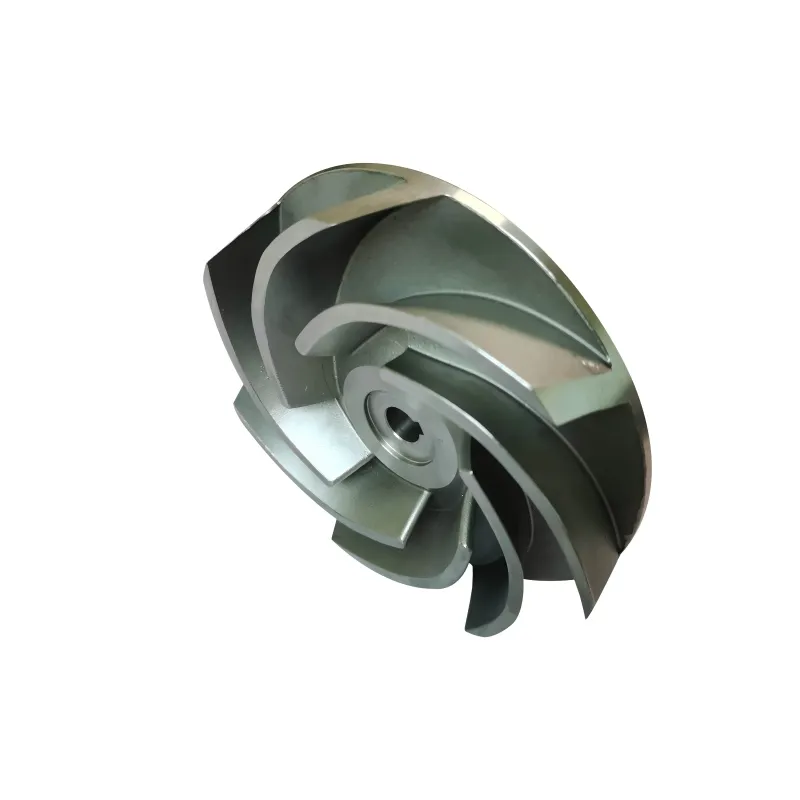
I remember evaluating a supplier for a series of pump impellers. One vendor's samples had beautiful aerodynamic surfaces but failed flow testing. We mapped them and found the vane profiles were subtly off—the pattern had been scaled with a single, uniform shrinkage factor. Another vendor, who had done similar work in the past, used a variable scale factor, thickening the pattern slightly more in the direction of the central hub's constraint. Their castings performed to spec. That's the hidden knowledge.
Quality is a Process, Not an Inspection
Finally, precision isn't verified at the end; it's built in at every step. It's the controlled environment of the wax room (temperature, humidity). It's the meticulous inspection of cluster assemblies before shelling. It's the documented firing curve of the autoclave for dewaxing and the furnace for sintering. A deviation in the shell firing temperature can alter its permeability and strength, leading to mistruns or shell cracking during pour.
The post-casting processes matter too. How do you cut the parts from the tree? A abrasive wheel can induce stress and micro-cracks if not done carefully. Heat treatment is another minefield. Solution treating a complex casting to optimize alloy properties without causing warpage or sintering scale that ruins surfaces is a delicate balance.
This holistic view is what separates a part supplier from a manufacturing partner. When a company like QSY emphasizes 30 years in casting and machining, it's code for having lived through these interconnected problems. They've likely seen how a change in shell sand affects machinability, or how a tweak to heat treatment can save a batch of parts with marginal dimensions. That's the texture of real-world precision lost wax investment casting—a deep, sometimes messy, always detailed craft of connecting a hundred variables to hit a single, unforgiving spec sheet. It's never just about the wax.