When you hear 'rapid investment casting', most think it's just about slapping 'fast' onto the old lost-wax process. That's the first pitfall. True rapidity here isn't just about cycle time compression; it's a systemic rethink of pattern production, shelling, and dewaxing, all while holding onto the dimensional fidelity that makes investment casting valuable. Many shops claim it, but the gap between claiming and delivering is where the real work—and the interesting failures—happen.
The Core Misconception: Speed vs. Integrity
The biggest mistake I see is the assumption that you can just accelerate a traditional process. You can't. Pouring money into faster 3D printers for patterns is one thing, but if your shell building schedule can't keep up, or your burnout cycle becomes unstable, you've just created a very expensive bottleneck. The 'rapid' part has to be engineered into every stage, and that engineering is non-negotiable. It's a balance, always a balance, between thermal dynamics of the new slurry formulations and the mechanical strength needed for handling.
For instance, we once tried to adopt a new UV-curable pattern material that promised a 60% reduction in pattern production time. The speed was real. The problem emerged during autoclave dewaxing. The different thermal expansion coefficient compared to our standard wax caused micro-cracks in the primary slurry coat, leading to a 40% shell failure rate in the first trial batch. That's the kind of 'rapid' that costs you more time and money. It forced us back to the lab to tweak the slurry's refractoriness and binder ratio specifically for that new material. The solution wasn't universal; it was a tailored fix.
This is where long-term operational experience becomes critical. A company like Qingdao Qiangsenyuan Technology Co., Ltd. (QSY), with their 30-year foundation in shell mold casting and investment casting, has likely seen these cycles of innovation and regression. That institutional memory on how materials behave under stress is what prevents a blind rush into every new 'rapid' solution. You can find more about their approach at their site, tsingtaocnc.com. Their specialization across cast iron to nickel-based alloys suggests they understand that 'rapid' parameters for stainless steel won't apply to a cobalt-based alloy. That's the nuance.
The Pattern Revolution: Beyond 3D Printing
Yes, 3D printing, specifically stereolithography (SLA) or binder jetting, is the gateway for most into rapid prototyping for casting. But treating the printed pattern as a direct wax substitute is a rookie error. The surface finish, the ash content after burnout, and the residual polymers all interact with the ceramic shell differently. You often need a secondary coating or a modified first slurry dip to seal the surface. We learned to run small validation batches—sometimes just a dozen shells—to dial in the process for a new pattern material or geometry before committing to a production run.
The real 'rapid' advancement, in my view, is in hybrid approaches. Using 3D printing to create master patterns for silicone tooling, from which you can then inject multiple wax or soluble pattern copies. This bridges the gap between one-off prototype speed and the need for small-batch production consistency. It's less sexy than full digital workflow, but it's often more reliable and cost-effective for runs of 20-50 pieces.
I recall a project for a turbine component in steel where the client needed 30 functional prototypes for engine testing. Pure 3D-printed patterns would have been prohibitively expensive. We printed a master, created a quick-turn urethane mold, and injected a low-melt-point alloy pattern. It added a week to the front-end but saved nearly three weeks in per-part pattern printing time and gave us much more consistent shell-building characteristics. The shells held, the castings were sound, and the client got their test series on schedule. That's practical rapid investment casting.
Shell Building: The Make-or-Break Phase
This is where the process either gains trust or falls apart. Accelerated drying is tempting—using forced air, dehumidifiers, or even gentle warmth. But rush it, and you trap moisture or create weak laminations between coats. The shell might look fine until it hits the furnace, then it fails catastrophically. We've moved to controlled environment rooms with precise humidity and temperature monitoring. It sounds basic, but this control allows us to predictably shorten inter-coat drying times by 20-30% without compromising integrity. It's not flashy, but it's effective.
The choice of stucco—the refractory sand applied between slurry dips—is another subtle lever. A coarser, more angular stucco can build shell thickness faster, reducing the number of required coats for a given thickness. But it can also create a rougher internal surface on the casting. For a part requiring fine surface finish, you might stick with finer stucco and accept more coats. There's no free lunch; every time-saving decision has a trade-off on another attribute.
For complex alloys, like the nickel-based alloys QSY works with, the shell chemistry itself is paramount. The shell must withstand the higher pouring temperatures without reacting with the molten metal. A 'rapid' process that uses a standard shell formulation for carbon steel will utterly fail with a superalloy. The shell might soften or create inclusions. So, the 'rapid' methodology must be alloy-specific. Their long-term work in special alloys, as noted in their company profile, implies they've had to develop (and likely protect) proprietary shell systems for these materials.
Dewaxing and Burnout: The Thermal Gauntlet
This is the most dramatic step. Traditional steam autoclaving works but can be slow for thicker patterns. Flash dewaxing in a high-temperature furnace is faster but imposes huge thermal shock on the shell. We've had shells literally explode when the wax expanded too rapidly. The compromise we've settled on is a two-stage approach: a brief, lower-pressure autoclave cycle to remove the bulk of the wax, followed by a controlled furnace burnout to eliminate the residue and sinter the shell. It's not the single fastest method, but it yields the highest shell survival rate for complex geometries.
The burnout cycle is another area ripe for optimization. The goal is to remove all pattern residue without over-stressing the ceramic. Thermocouples placed inside dummy shells help map the thermal gradient. By analyzing this data, we've been able to design faster ramp-up segments in the temperature zones where the shell is most stable, and slow down through critical transition phases. It shaved about 25% off our total furnace time. It's a data-driven kind of 'rapid', not a guess.
Failure here is expensive. A cracked shell discovered after burnout means you've lost all the time and cost invested up to that point—pattern, slurry, labor, energy. That's why the 'rapid' mindset must include robust process validation. You speed up the steps you can control and measure, and you leave buffers where the risks are high.
Machining Integration: The Critical Finish
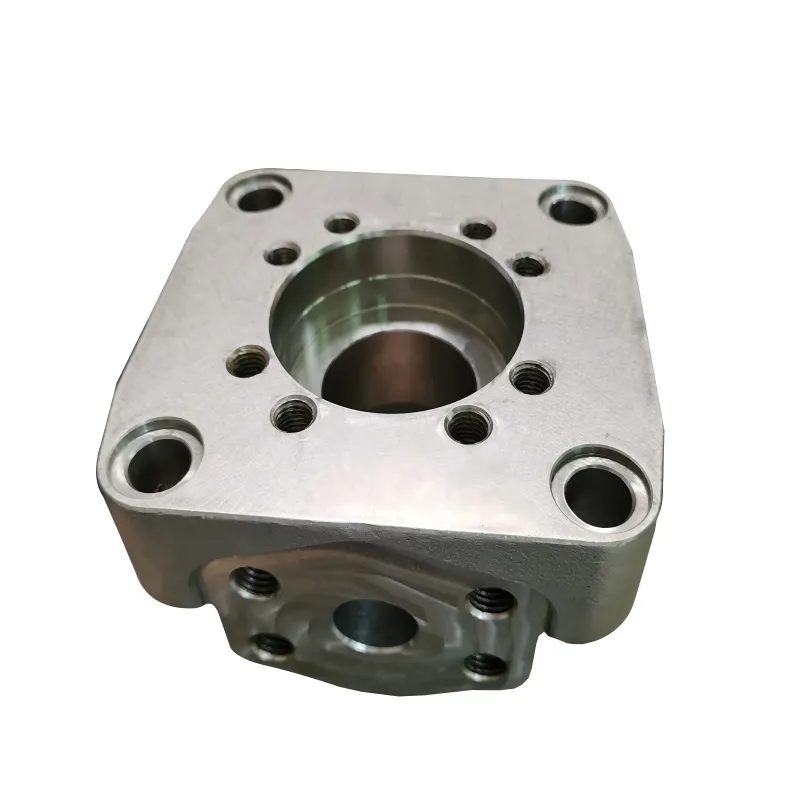
Rapid investment casting isn't done when the part is shaken out of the shell. The as-cast state almost always requires some CNC machining—drilling, milling critical faces, threading. This is where the 'rapid' chain can break again if the casting isn't designed for manufacturability (DFM) from the start. If you save two weeks on casting but then need three weeks of complex, multi-axis machining because of poor datum surfaces or inaccessible features, you've lost the race.
Close collaboration between the foundry and the machine shop is essential. At an integrated operation like QSY, where casting and CNC machining are under one roof, this handoff should be seamless. They can design the casting process with machining fixtures in mind, add minimal stock in the right places, and ensure the alloy's machinability is considered. For example, a certain grade of stainless steel might cast beautifully but be a nightmare to machine if the heat treatment isn't managed correctly post-casting. An integrated provider handles that continuum.
The most successful rapid projects I've been part of always involved the machinists in the early design reviews. They'd point out a small draft angle change that would allow for a simpler fixture, or suggest relocating a parting line to create a cleaner datum. Those conversations, happening upfront, are what make the entire pipeline—from digital model to finished, machined component—truly rapid and reliable.
Conclusion: It's a Philosophy, Not a Button
So, after all this, what is rapid investment casting? It's not a single technology you buy. It's a philosophy of integrated process optimization, backed by deep materials knowledge and a willingness to run controlled experiments (and accept some failures). It's about knowing where you can push and where you must be patient. It's the difference between a shop that just makes castings and one that delivers engineered solutions under time pressure.
The companies that do this well, the ones with decades of track record across diverse materials like cast iron and special alloys, have earned their speed. They've built it through accumulated, sometimes painful, experience. They've learned that true rapidity is about reducing total lead time to a functional, qualified part, not just about the hours the metal spends in the mold. That's the real goal, and it's a lot harder—and more interesting—than it sounds.