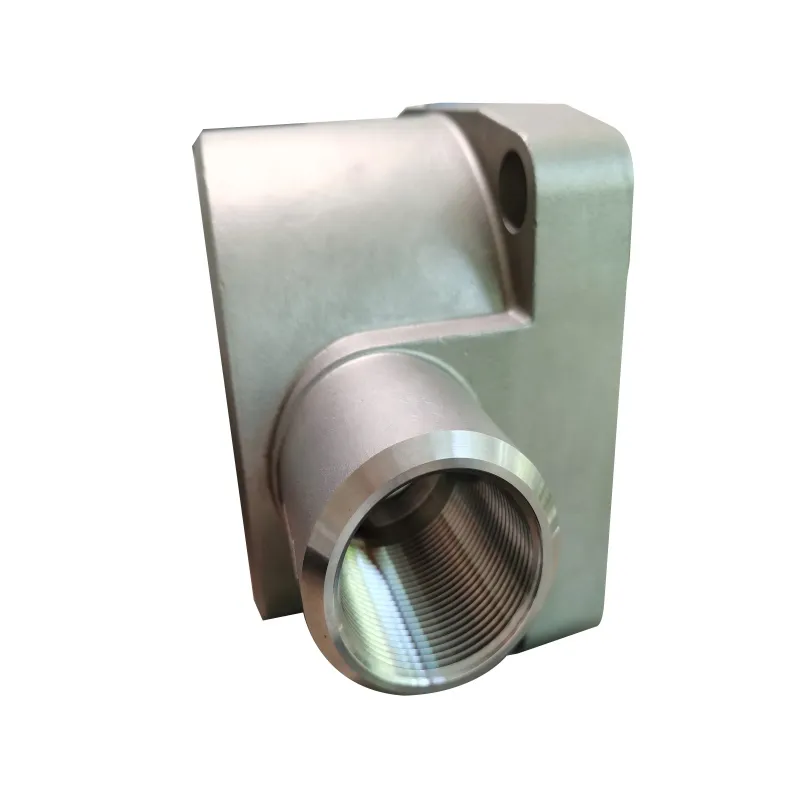
When you hear 'steel sand casting,' the immediate image is often a rough, heavy, and somewhat crude component. That's the first misconception. It's not just about dumping molten steel into a sand box. The reality is a nuanced process where the choice of sand, binder, and gating design dictates whether you get a viable part or a pile of scrap. Many assume it's the 'cheap and dirty' option, but in applications like heavy machinery bases, large valve bodies, or certain marine fittings, it's often the only technically and economically viable route for low-to-medium volume production. The trick isn't just making a casting; it's making one that minimizes subsequent machining and lasts in service.
The Core of the Process: Sand is Not Just Sand
Let's get granular. The 'sand' in steel sand casting is rarely just silica from a beach. For steel, which pours at much higher temperatures than iron or aluminum, you need refractory integrity. We often use chromite sand or zircon sand for critical surfaces or heavy sections to prevent burn-on and penetration defects. It's more expensive, but the cost of a surface defect that requires hours of grinding or leads to a leak path in a pressure-retaining part is far higher. I've seen projects fail because they tried to save $0.50 per kilo on sand, only to spend ten times that on rework.
The binder system is another battlefield. Furan resin, phenolic urethane, sodium silicate with CO2 – each has its own trade-off between strength, collapsibility (critical to avoid hot tearing in steel), and environmental/odor concerns. With furan, if the nitrogen content isn't controlled for the grade of steel you're pouring, you can get nasty gas porosity just beneath the skin, which only shows up after machining. Learned that the hard way on a batch of pump housings years ago.
Pattern making is where the theoretical meets the practical. For steel, shrinkage allowance is around 2% – more than iron. But it's not uniform. A long, constrained geometry might shrink less, while a free-cube section pulls more. You compensate with experience, sometimes adding 'shrink rulers' to patterns. For a company like Qingdao Qiangsenyuan Technology Co., Ltd. (QSY), with their 30-year history, this pattern database is invaluable. They've likely seen how different steel grades behave in their shop floor conditions, which is irreplaceable tacit knowledge. You can't get that from a CAD model alone.
Where Steel Sand Casting Makes Sense (And Where It Doesn't)
It's not a universal solution. For high-precision, thin-walled, or massively complex internal geometries, investment casting or shell molding might be better. But for parts weighing from 50kg to several tons, with relatively simple or moderately complex shapes, sand casting is king. Think about a counterweight for an excavator, or the main frame for a hydraulic press. The tooling (wood or urethane pattern) cost is low, and design changes are relatively easy to accommodate.
I recall a project for a mining equipment manufacturer. They needed a series of large gear blanks, about 800kg each, in 4140 steel. The initial thought was to forge them, but the lead time and cost for the die were prohibitive for the quantity. We went with sand casting, using chromite sand for the cope to achieve a better as-cast surface finish on the gear OD. The key was the feeding and risering design to ensure soundness in the hub section, which would later carry the gear teeth. It worked, and the unit cost was about 40% lower than the forged quote.
The limitation, of course, is surface finish and dimensional tolerance. You're looking at a typical surface roughness of Ra 12.5-25 μm, and tolerances are per ISO 8062 CT 10-13 range, depending on size. That means you must plan for machining allowances on critical datum features and sealing surfaces. Anyone who expects a net-shape finish straight from the sand mold is setting themselves up for disappointment and will blame the process unfairly.
The Critical Link: From Casting to Finished Part
This is where many foundries fall short, and where integrated suppliers add real value. A sand-cast steel part is almost never the final product. It needs machining, often heat treatment, and testing. Having the machining capability in-house, or in tight coordination like QSY does with their CNC machining division, eliminates a huge layer of logistics, blame-shifting, and quality ambiguity.
When the same entity that pours the casting also machines it, they have a vested interest in getting the casting right. They know where the likely shrinkage areas are, so they can adjust machining stock accordingly. They understand the potential for hard spots from chilling, so they can plan tool paths and select inserts to handle it. I've been in too many situations where the foundry blames the machinist for 'not cleaning up,' and the machinist blames the foundry for 'hard spots and voids.' It's a toxic cycle that kills projects.
For materials like stainless steels or those special alloys QSY mentions – nickel-based or cobalt-based – this integration is even more critical. These alloys are tough to machine and expensive. A casting defect that ruins a part after 80% of the machining is done is a massive financial loss. The foundry mindset has to extend through the entire value chain.
Common Pitfalls and How to Sidestep Them
Cold shuts and mistruns are classic issues with steel in sand molds. Steel loses heat quickly. If the gating system is too long or thin, or the pouring temperature is off by even a small margin, the metal can freeze before filling the mold. The solution isn't just cranking up the pouring temperature – that can cause other problems like excessive shrinkage and mold erosion. It's about designing a gating system with the right choke area, using multiple ingates, and sometimes even heating the molds for very large, complex castings.
Shrinkage porosity is the other big beast. Steel has a high volumetric shrinkage. You need risers (feeders) that are large enough and placed correctly to feed liquid metal to the solidifying sections until they are fully solid. Computer simulation helps now, but it still needs validation. We once simulated a valve body, and the software said we needed three risers. Based on a similar past job, we used four slightly smaller ones in different locations. The physical casting was sound; the simulation had slightly misjudged the cooling dynamics of a particular sand core. Experience still trumps pure theory.
Dimensional drift over a production run is a subtle killer. Wooden patterns can absorb moisture and swell. The molding process itself can have variability – sand compaction, core shifting. For a long-running job, it's wise to schedule periodic checks of a 'first-off' casting's critical dimensions before machining the entire batch. It saves a world of pain.
Looking at the Bigger Picture
So, is steel sand casting a dying art? Not at all. It's evolving. The fundamentals of heat transfer and solidification don't change, but the tools around them do. Better sand reclamation systems make environmental and economic sense. 3D printing of sand molds and cores is opening doors for prototyping and complex geometries that were once impossible with traditional patterns, though for high-volume production, the economics still favor conventional tooling.
The real value, in my view, lies in foundries that treat it as an engineered solution rather than a commodity. It's about understanding the entire journey of the part, from the CAD model to the finished, machined component in the customer's assembly. Suppliers who offer that, combining processes like casting and precision machining under one roof, provide a reliability that's hard to match. When you look at a company's offering, like the integrated shell mold, investment casting, and CNC machining services detailed on https://www.tsingtaocnc.com, it signals a capability to handle not just the pour, but the realization of a functional part. That's where the industry is headed.
Ultimately, successful steel sand casting is a dialogue – between the designer and the foundry engineer, between the metallurgist and the machinist. It's about managing expectations, understanding compromises, and leveraging decades of collective, sometimes painful, experience to turn molten metal into something robust and reliable. It's never just about the sand.