When you hear 'types of sintering,' most textbooks jump straight to the classic solid-state vs. liquid-phase distinction. That's fine in theory, but on the shop floor, that binary choice feels almost naive. The real decision is messier, driven by the alloy powder you're stuck with that morning, the part geometry that engineering just threw over the wall, and the constant pressure from production to hit density targets without blowing the energy budget. I've seen too many juniors fixate on picking the 'right' type from a chart, only to have the furnace tell a different story. Let's talk about what actually happens when the furnace door closes.
Solid-State Sintering: The Workhorse and Its Hidden Quirks
This is the default, the baseline. You're consolidating powders below the melting point of the major constituent, relying on atomic diffusion. For a lot of our ferrous components at QSY, especially the simpler structural parts from iron or low-alloy steel powders, this is where we start. The process seems straightforward—ramp up, hold, cool down. But the devil's in the details, specifically the atmosphere control. Get a tiny leak in your vacuum furnace or a hiccup in your hydrogen/nitrogen mix, and you're not just looking at surface oxidation. You're altering the diffusion kinetics at the neck regions between particles, leading to weak bonds and a part that'll fail under machining. We learned this the hard way years ago on a batch of gear blanks; the sintered density looked fine on the report, but they chattered and fractured during the hobbing process. The culprit? A slightly oxidizing atmosphere that created a thin, brittle oxide film at the grain boundaries, invisible to standard density checks.
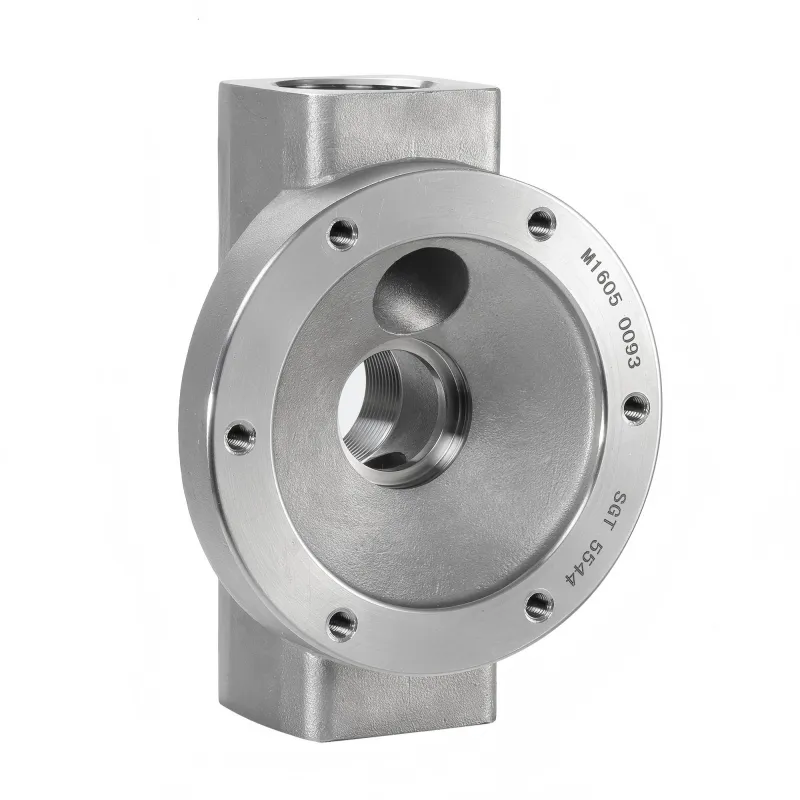
The heating rate is another silent variable. Textbook curves are smooth. In reality, if you ramp too fast with certain compacted shapes, you can create internal stresses that cause differential shrinkage or even warping. It's not just about reaching the soak temperature; it's about how you get there. For complex shapes we machine post-sintering, like some of the stainless steel valve bodies we handle, a controlled, multi-stage ramp is non-negotiable to maintain dimensional stability for the subsequent CNC operations.
And let's not forget the powder itself. The assumption of 'pure' solid-state sintering gets blurry with pre-alloyed powders. Even with elements like nickel or copper in steel powders, you might get localized transient liquid phases if a temperature hotspot occurs. So, you're aiming for solid-state, but you need to be aware you might be flirting with something else. It's this gray area that separates a recipe from a robust process.
Liquid Phase Sintering: Where Things Get Interesting (and Sticky)
Now this is where you actively introduce a lower-melting-point component. The classic example is adding copper to iron. The idea is beautiful: the liquid forms, wets the solid grains, and through capillary action and solution-reprecipitation, you get rapid densification. The reality on the production line is a constant battle against gravity and time—slumping. If the liquid volume fraction is too high or the viscosity too low, your carefully pressed part can sag or lose its shape in the furnace. I remember a project for a high-density bearing where we were pushing the copper content. We got the density, alright, but the part came out looking like a sad, melted candle. We had to dial back, accept a slightly lower initial density from pressing, and use a much more precise sintering profile to control the liquid phase duration.
The wetting angle is everything. If the liquid doesn't wet the solid grains properly, it balls up inside pores instead of spreading along grain boundaries. You end up with isolated, large pores and poor strength. This isn't just a materials science parameter; it's affected by surface oxides, minor impurities, and the furnace atmosphere. For the special alloys we work with, like some nickel-based ones, selecting the correct sintering aid is a proprietary art. It's less about following a handbook and more about iterative testing, often in partnership with our powder suppliers.
Then there's the microstructure. With liquid phase sintering, you're often left with a composite structure—solid grains surrounded by a different phase. This can be great for wear resistance or specific magnetic properties, but it dramatically changes how the part machines. When our CNC division at Qingdao Qiangsenyuan Technology Co., Ltd. (QSY) gets a liquid-phase sintered part, the machining parameters (speed, feed, tool grade) need a complete review compared to a solid-state sintered part of the same base material. The hardness isn't uniform, and tool wear patterns are unpredictable if you treat it like a homogeneous piece.
Pressure-Assisted Sintering: The Density Game Changer
Sometimes, conventional sintering just won't get you there, especially for full densification or with tricky materials like refractory metals or certain ceramics. That's where you bring in the big guns: pressure. Hot Pressing (HP) and Hot Isostatic Pressing (HIP) are in a different league. We don't use these for high-volume, low-cost parts—the cycle time and equipment cost are prohibitive. But for a one-off prototype or a critical component in a special alloy, like a cobalt-based alloy seal for extreme environments, HIP is a lifesaver.
Hot Isostatic Pressing is fascinating. You put the green part in a sealed can, evacuate it, and then subject it to high temperature and isostatic gas pressure (argon, usually). The pressure collapses internal pores from all directions, leading to near-theoretical density. The catch? The canning process is an art form. Any leak, and the gas gets in, ruining the part. And the dimensional change is highly predictable but not always trivial to compensate for in the initial tooling. We've used HIP for densifying complex investment-cast components as well, which blurs the line between traditional casting and powder metallurgy techniques.
The practical limitation, beyond cost, is part size. Your universe is defined by the diameter and height of your HIP vessel. For larger components, you're back to wrestling with conventional sintering and its compromises. It's a tool, a very powerful one, but not a universal solution.
Spark Plasma Sintering and Other Field-Assisted Tricks
This is the frontier stuff, often confined to R&D labs or very niche production. Spark Plasma Sintering (SPS) or Field-Assisted Sintering Technique (FAST) uses pulsed direct current and uniaxial pressure. The big sell is speed—incredibly fast heating rates and short dwell times, which can theoretically suppress grain growth. It's brilliant for nanomaterials or preserving unique powder structures.
But from a production standpoint, it's tricky. Scale-up is the main hurdle. Making large, complex shapes uniformly with SPS is a challenge we're still watching from the sidelines. The other issue is that the very fast cycle can sometimes leave residual stresses or create density gradients if the die design and current paths aren't perfect. For a company like QSY, with a focus on delivering reliable cast and machined components, we monitor these advancements closely. They might be relevant for a future project involving a novel alloy powder, but for now, they remain a specialized tool. The key takeaway is that the 'type' of sintering isn't just a choice; it's a constraint defined by the equipment you have access to and the economic batch size.
The Overlooked Factor: Sintering as Part of a Chain, Not an Island
This is perhaps the most critical point from 30 years in this business. You cannot isolate the sintering step. Its success or failure is determined by what comes before and after. The powder characteristics (size distribution, morphology, lubricant) set the stage. The compaction method (uniaxial, isostatic, metal injection molding) defines the green density and pore structure the sintering has to work with.
And crucially, what comes after? If the part goes straight to service, the sintering must deliver final properties. But at QSY, many of our powder-processed parts undergo significant CNC machining. A poorly sintered part might have hidden subsurface porosity or inconsistent hardness, which will cause tool breakage, poor surface finish, and scrapped parts during machining—wasting all the value added up to that point. The sintering profile must be developed with the machinist in mind. Sometimes, it's better to sinter to a slightly lower density that is very uniform, machine it, and then use a secondary operation like a low-temperature anneal or even a surface treatment to hit final specs.
Finally, the furnace itself is a living system. The refractory lining degrades over time, affecting thermal uniformity. Heating elements age. Thermocouples drift. A sintering 'type' isn't a static recipe; it's a living process that needs constant monitoring and adjustment. The best practitioners I know have a feel for their furnaces—they listen to them, watch the color of the parts coming out, and correlate that with the data logs. It's this synthesis of science, equipment intuition, and an understanding of the entire manufacturing chain that turns a sintering specification into a reliable, day-in, day-out production process. It's less about choosing a type and more about mastering the variables within the type your project demands.