At its core, metal casting is the art and science of transforming molten alloy into engineered components — a discipline that bridges ancient craftsmanship with modern metallurgy. For industrial buyers and engineers, understanding these fundamentals of metal casting is the key to specifying reliable, cost-effective cast iron parts. As a leading China high quality cast iron parts manufacturer, we combine decades of foundry expertise with full-scale custom metal casting capabilities. Whether you require high-precision gravity cast iron parts, complex shell molding cast iron parts, or high-ductility ductile iron mechanical parts, our metal casting foundry delivers OEM solutions with exceptional cost performance. From agricultural machinery parts to railway train spare parts, we serve as your strategic partner. (For context, while diy metal casting exists as a hobby, industrial applications demand the rigor of a professional foundry.)
1. What is Metal Casting? Definition & Core Principles
1.1 Defining the process: from pattern to cast iron part
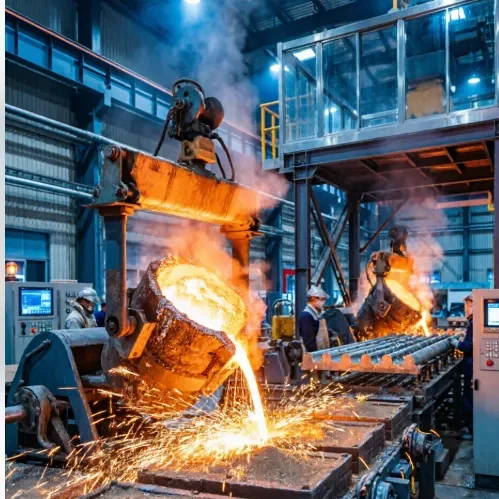
Metal casting is a manufacturing process in which molten metal is poured into a mold cavity that replicates the desired part geometry, allowing it to solidify into a finished or near‑finished component. The basic casting cycle consists of several critical steps: patternmaking, molding, melting, pouring, solidification, cooling, and finishing. The pattern, typically made from wood, metal, or plastic, creates the cavity in the mold. For complex internal geometries, cores are inserted to form passages like those in pump and valve castings. Once the mold is prepared, the selected alloy—such as gray iron or ductile iron—is melted in a furnace (cupola, electric induction, or electric arc furnace) and poured at carefully controlled temperatures. Solidification begins as the metal cools, transforming from liquid to solid within the mold. After complete solidification, the casting is shaken out, cleaned, heat‑treated if required, and machined to final tolerances.
Why cast iron parts dominate machinery: Cast iron remains the material of choice for countless industrial applications due to three inherent advantages: vibration damping, wear resistance, and machinability. Gray iron, with its flake graphite structure, absorbs vibrational energy exceptionally well—making it ideal for machine tool bases, engine blocks, and construction machinery parts that must operate quietly and precisely. The graphite also acts as a built‑in lubricant, enhancing wear resistance in sliding applications like brake drums and hardware clamping fixtures. Furthermore, cast iron’s machinability allows high‑speed cutting with minimal tool wear, reducing overall production costs. These characteristics explain why cast iron parts continue to be specified in heavy trucks, agricultural equipment, and railway train spare parts.
1.2 The fundamentals of metal casting: fluid flow, solidification, shrinkage
Understanding the fundamental physics behind casting is essential for producing sound, defect‑free components.
Fluidity of molten metal refers to its ability to fill thin sections and intricate details before freezing. Fluidity depends strongly on alloy composition and pouring temperature. Gray iron, with its high carbon equivalent and near‑eutectic composition, exhibits excellent fluidity—it can flow through walls as thin as 3 mm. Ductile iron, while less fluid due to its magnesium treatment, still fills complex geometries when properly designed gating systems are used. This is critical for producing agricultural machinery parts with thin ribs or railway train spare parts with intricate brake passages.
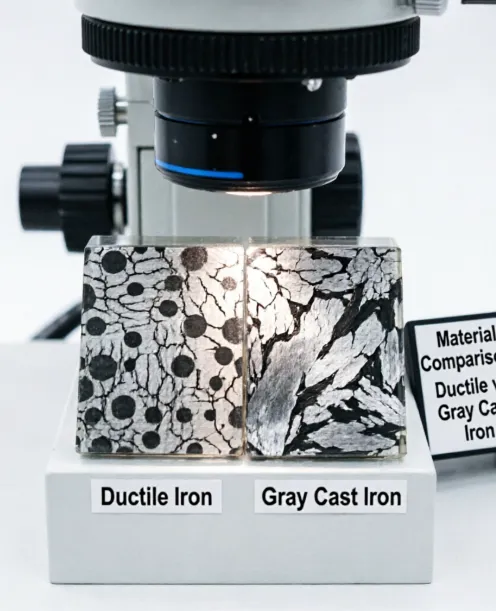
Solidification mechanisms determine the final microstructure and mechanical properties. As molten metal cools, crystals (nuclei) form and grow. In gray iron, the graphite precipitates as flakes during eutectic solidification, giving gray cast iron mechanical parts their characteristic fracture appearance and damping capacity. In ductile iron, the graphite forms spherical nodules because of magnesium or cerium inoculation—this nodular morphology eliminates stress concentrations and provides the elongation and toughness required for ductile iron mechanical parts. The solidification mode also affects shrinkage behavior: gray iron expands slightly during graphite formation (graphitization expansion), which helps reduce macro‑shrinkage, while ductile iron undergoes greater liquid‑to‑solid contraction and requires effective feeding.
Shrinkage allowance and riser design: All metals contract as they cool and solidify. To prevent internal cavities (porosity) in pump and valve castings or hydraulic manifolds, foundry engineers design risers (feeders)—reservoirs of molten metal that compensate for volumetric shrinkage. Risers must remain liquid until the casting solidifies completely. For complex metal casting geometries, software simulation predicts hot spots and optimizes riser placement, ensuring pressure tightness in valve bodies and structural integrity in heavy truck and auto parts.
1.3 Contrast with diy metal casting & historical context
How backyard casting differs from industrial metal casting foundry quality control: DIY metal casting, popular among hobbyists and artists, typically uses simple methods like lost‑foam or green sand casting in small backyard foundries. While it can produce functional art or prototypes, it lacks the rigorous quality controls of an industrial metal casting foundry. Professional foundries employ spectroscopic analysis for every melt, mechanical testing (tensile, hardness, impact), non‑destructive examination (ultrasonic, magnetic particle), and dimensional inspection with CMMs. For critical applications—railway train spare parts, construction machinery parts, or safety‑critical automotive components—this level of control is non‑negotiable. The metallurgical consistency, traceability, and engineering support provided by a professional foundry cannot be replicated in a DIY setting.
Brief evolution: from art to precision engineering: Casting is one of the oldest manufacturing arts, dating back to 4000 BCE. Ancient civilizations cast bronze tools and weapons. The Industrial Revolution brought mechanization and the widespread use of cast iron for bridges, engines, and machinery. Today, casting has evolved into a high‑precision engineering discipline, integrating computer simulation, automated molding lines, and advanced metallurgy. Modern construction machinery parts and agricultural machinery parts are produced to tolerances that would have been unimaginable a century ago. This evolution underscores the importance of partnering with a skilled metal casting foundry that combines tradition with technology.
2. Core Casting Processes for Industrial Cast Iron Components
2.1 Gravity die casting — gravity cast iron parts
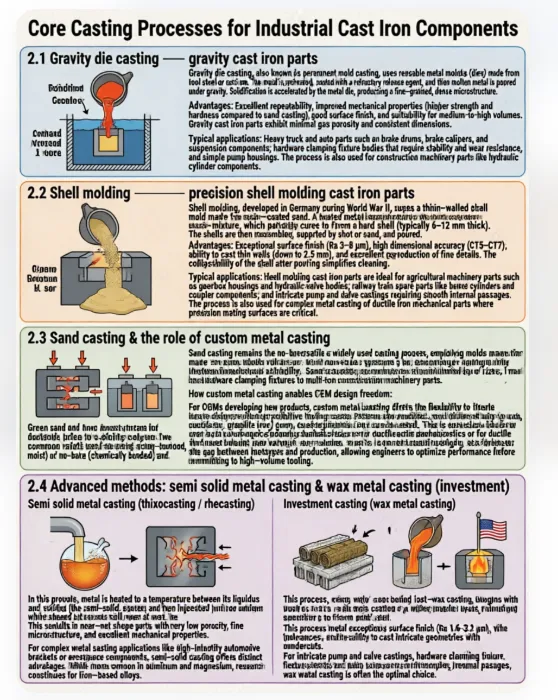
Gravity die casting, also known as permanent mold casting, uses reusable metal molds (dies) made from tool steel or cast iron. The mold is preheated, coated with a refractory release agent, and then molten metal is poured under gravity. Solidification is accelerated by the metal die, producing a fine‑grained, dense microstructure.
Advantages: Excellent repeatability, improved mechanical properties (higher strength and hardness compared to sand casting), good surface finish, and suitability for medium‑to‑high volumes. Gravity cast iron parts exhibit minimal gas porosity and consistent dimensions.
Typical applications: Heavy truck and auto parts such as brake drums, brake calipers, and suspension components; hardware clamping fixture bodies that require stability and wear resistance; and simple pump housings. The process is also used for construction machinery parts like hydraulic cylinder components.
2.2 Shell molding — precision shell molding cast iron parts
Shell molding, developed in Germany during World War II, uses a thin‑walled shell mold made from resin‑coated sand. A heated metal pattern is covered with a sand‑resin mixture, which partially cures to form a hard shell (typically 6–12 mm thick). The shells are then assembled, supported by shot or sand, and poured.
Advantages: Exceptional surface finish (Ra 3–8 µm), high dimensional accuracy (CT5–CT7), ability to cast thin walls (down to 2.5 mm), and excellent reproduction of fine details. The collapsibility of the shell after pouring simplifies cleaning.
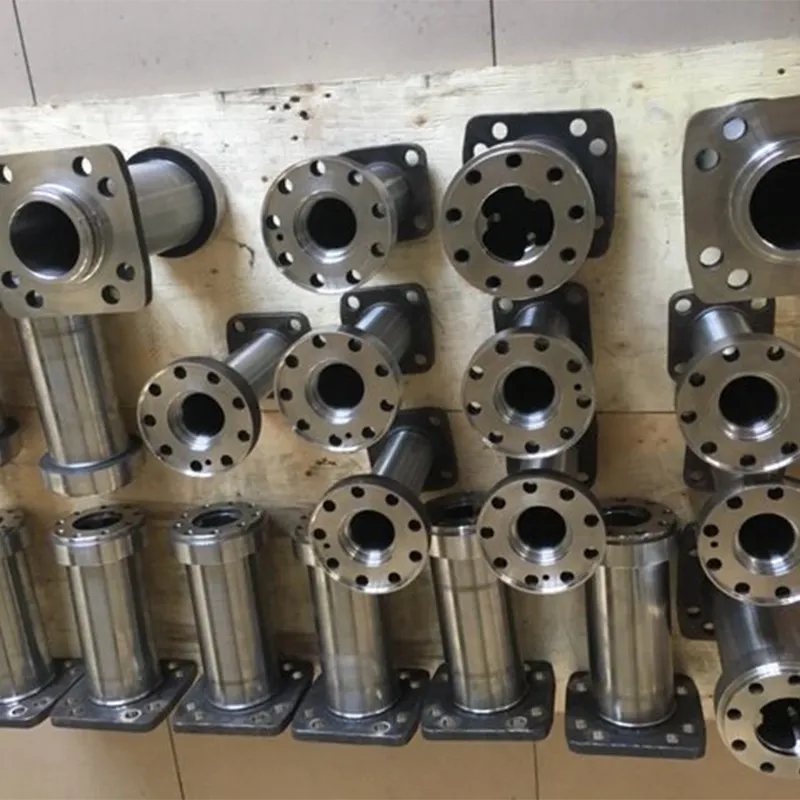
Typical applications: Shell molding cast iron parts are ideal for agricultural machinery parts such as gearbox housings and hydraulic valve bodies; railway train spare parts like brake cylinders and coupler components; and intricate pump and valve castings requiring smooth internal passages. The process is also used for complex metal casting of ductile iron mechanical parts where precision mating surfaces are critical.
2.3 Sand casting & the role of custom metal casting
Sand casting remains the most versatile and widely used casting process, employing molds made from bonded silica sand. Two common variants are green sand (clay‑bonded, moist) and no‑bake (chemically bonded) sand.
Green sand and no‑bake systems for low‑to‑medium volumes: Green sand casting is economical for prototypes and short runs, while no‑bake systems produce larger castings with better dimensional stability. Sand casting accommodates an unlimited range of sizes, from small hardware clamping fixtures to multi‑ton construction machinery parts.
How custom metal casting enables OEM design freedom: For OEMs developing new products, custom metal casting offers the flexibility to iterate designs without prohibitive tooling costs. Patterns can be modified, and different alloys (gray iron, ductile iron, compacted graphite iron) can be tested. This is especially valuable for gray cast iron mechanical parts that require specific damping characteristics or for ductile iron mechanical parts that must meet varying strength requirements. Custom metal casting bridges the gap between prototype and production, allowing engineers to optimize performance before committing to high‑volume tooling.
2.4 Advanced methods: semi solid metal casting & wax metal casting (investment)
Semi solid metal casting (thixocasting / rheocasting): In this process, metal is heated to a temperature between its liquidus and solidus (the semi‑solid state) and then injected into a die under high pressure. The semi‑solid slurry exhibits thixotropic behavior—it flows when sheared but stands still when at rest. This results in near‑net shape parts with very low porosity, fine microstructure, and excellent mechanical properties. For complex metal casting applications like high‑integrity automotive brackets or aerospace components, semi‑solid casting offers distinct advantages. While more common in aluminum and magnesium, research continues for iron‑based alloys.
Investment casting (wax metal casting): Investment casting, also called lost‑wax casting, begins with a wax pattern that is coated with multiple layers of ceramic slurry to form a shell. The wax is then melted out (lost), and the ceramic shell is fired, leaving a precise mold cavity. Molten metal is poured, and after solidification, the shell is broken away. This process yields exceptional surface finish (Ra 1.6–3.2 µm), tight tolerances, and the ability to cast intricate geometries with undercuts. For intricate pump and valve castings, hardware clamping fixture details, and railway train spare parts with complex internal passages, wax metal casting is often the optimal choice.
3. Cast Iron Materials: Gray, Ductile, and Mechanical Properties
3.1 Gray cast iron mechanical parts — structure & applications
Gray iron derives its name from the gray fracture surface caused by flake graphite. The graphite flakes act as stress concentrators, which limit tensile strength and ductility but provide outstanding damping capacity and thermal conductivity.
Flake graphite: damping, thermal conductivity: The interconnected graphite flakes effectively damp vibrations, making gray iron the preferred material for machine tool bases, engine blocks, and construction machinery parts like gear housings and frames. The graphite also conducts heat away from hotspots, which is why gray iron is used for brake drums and disc brakes in heavy truck and auto parts.
Typical applications: Gray cast iron mechanical parts are widely used in pump and valve castings for moderate pressures, construction machinery parts requiring dimensional stability, and general industrial machinery where cost and damping are priorities.
3.2 Ductile iron mechanical parts / Ductile Iron casting — strength & toughness
Ductile iron, also known as nodular or spheroidal graphite iron, was invented in the 1940s. By adding magnesium or cerium to molten iron, the graphite precipitates as spherical nodules rather than flakes. This morphology eliminates stress concentrations, imparting significant ductility and toughness.
Nodular graphite: high elongation, impact resistance: Ductile iron mechanical parts can elongate 5–18% depending on grade, making them suitable for dynamic and impact‑loaded applications. Railway train spare parts like couplers, suspension components, and brake hangers rely on ductile iron’s ability to absorb shock without fracture. Agricultural machinery parts such as plow shares, gearbox housings, and lift arms benefit from the combination of strength and wear resistance.
Grades and selection: Common ductile iron grades include 60‑40‑18 (ferritic, high ductility), 80‑55‑06 (pearlitic/ferritic, balanced properties), and 100‑70‑03 (pearlitic, high strength). For heavy truck and auto parts like axle housings, spring hangers, and engine mounts, grade 80‑55‑06 or 65‑45‑12 is frequently specified. The selection depends on the required combination of strength, ductility, and fatigue resistance.
3.3 Specialized cast iron families
Compacted graphite iron (CGI): CGI has graphite morphology intermediate between flake and nodular—vermicular or compacted. It offers higher strength and stiffness than gray iron, with better thermal conductivity and damping than ductile iron. CGI is used in demanding applications like diesel engine blocks, brake discs for high‑performance vehicles, and pump and valve castings subjected to thermal cycling.
Alloyed irons for extreme wear: Nickel, chromium, molybdenum, and copper are added to enhance hardenability, corrosion resistance, or high‑temperature strength. Ni‑hard (martensitic white iron) is used for slurry pumps and mining equipment. High‑silicon ductile iron (SiMo) serves exhaust manifolds and turbocharger housings.
Heat treatment effects: Annealing (ferritizing) improves ductility, normalizing increases strength, and austempering produces austempered ductile iron (ADI) with exceptional strength‑to‑weight ratios—ideal for gears, agricultural machinery parts, and hardware clamping fixtures requiring extreme wear resistance.
4. Industrial Applications: From Railway to Heavy Machinery
4.1 Railway Train Spare Part castings
Railway components must withstand decades of cyclic loading, impact, and environmental exposure. Common railway train spare parts produced as castings include:
-
Brake components: Brake cylinders, brake hangers, and brake shoe holders. These require reliable ductile iron mechanical parts with guaranteed elongation and fatigue strength.
-
Coupler housings and yokes: Safety‑critical parts that transmit traction and buffing forces. Ductile iron casting (grade 80‑55‑06 or 100‑70‑03) ensures toughness and resistance to brittle fracture.
-
Suspension parts: Spring seats, equalizer beams, and axle box housings. Complex metal casting techniques produce the intricate shapes needed for modern bogie designs.
4.2 Heavy Truck and Auto Parts & construction machinery parts
The commercial vehicle and construction equipment sectors demand robust, reliable castings that endure extreme loads and abrasive environments.
-
Heavy truck and auto parts: Axle housings (banjo or split type), differential carriers, gearbox cases, brake drums, and engine mounts. Ductile iron mechanical parts dominate where fatigue matters, while gray cast iron mechanical parts are chosen for damping and machinability in engine blocks and flywheels.
-
Construction machinery parts: Excavator undercarriage components (sprockets, rollers), crane counterweights, hydraulic manifold blocks, and gear housings. Gravity cast iron parts provide the density needed for high‑pressure hydraulics, while shell molding cast iron parts ensure precision for valve interfaces.
4.3 Agricultural machinery parts & hardware clamping fixture
Agriculture relies on durable, wear‑resistant castings that operate in dirt, moisture, and varying loads.
-
Agricultural machinery parts: Tractor transmission housings, differential casings, plow shares, cultivator points, and combine harvester components. Ductile iron mechanical parts (often austempered) resist abrasive wear, while gray iron provides cost‑effective damping for gearboxes.
-
Hardware clamping fixture: Precision jigs, fixture bases, clamping arms, and tooling bodies. These require excellent dimensional stability and flatness. Gravity cast iron parts and shell molding cast iron parts are commonly used to achieve repeatable accuracy.
4.4 Pump and valve castings — pressure tightness & corrosion resistance
Fluid handling components must be pressure‑tight, corrosion‑resistant, and dimensionally accurate.
-
Valve bodies, bonnets, and gates: For water, oil, gas, and chemical services. Gray cast iron mechanical parts are suitable for low‑pressure applications (up to PN16), while ductile iron casting extends the pressure range and provides impact resistance for harsh environments.
-
Impellers and pump housings: Complex metal casting (often investment casting) produces the intricate flow passages needed for high efficiency. Wax metal casting is employed for stainless steel and high‑alloy pumps. Quality control includes pressure testing, X‑ray inspection, and dimensional verification.
5. Why Partner with a China High Quality Cast Iron Parts Manufacturer?
5.1 China-based high quality manufacturer & factory advantages
China has become a global hub for metal casting due to its combination of technical expertise, modern infrastructure, and cost efficiency. A China high quality cast iron parts manufacturer typically offers:
-
Vertically integrated facilities: In‑house pattern making, melting, molding, heat treatment, machining, and quality assurance. This reduces lead times and ensures single‑source accountability.
-
Certifications: ISO 9001, IATF 16949 (automotive), and railway specific certifications (IRIS) demonstrate commitment to quality systems.
-
High cost performance: Competitive pricing achieved through economies of scale, efficient manufacturing, and a robust supply chain—without compromising on high quality. The term “high cost performance” means optimal value: the best possible quality for the investment.
5.2 OEM & custom metal casting capabilities
A reliable OEM metal casting supplier offers comprehensive engineering support:
-
From prototype to volume production: Custom metal casting services allow clients to develop new products with confidence. Rapid prototyping (3D‑printed patterns or rapid sand casting) accelerates design validation. Once the design is finalized, production tooling is created for gravity, shell molding, or investment casting.
-
Engineering support: Simulation software (solidification modeling, stress analysis) predicts defects and optimizes gating/riser design. Metallurgical consultation ensures the correct alloy selection—whether ductile iron mechanical parts requiring high elongation or gray cast iron mechanical parts needing damping.
-
Unique capabilities: For ductile iron mechanical parts, the manufacturer controls nodularity (typically >85% nodularity) through careful inoculation. For shell molding cast iron parts, precise pattern equipment ensures repeatability.
5.3 Reliable supplier & product portfolio
A trusted China cast iron parts factory provides a broad portfolio:
-
Full range: Gravity cast iron parts, shell molding cast iron parts, complex metal casting, agricultural machinery parts, pump and valve castings, railway train spare parts, heavy truck and auto parts, and hardware clamping fixtures.
-
Quality control: Every melt is analyzed by spectroscopy. Mechanical testing (tensile, hardness, impact) verifies properties. Non‑destructive testing (ultrasonic, magnetic particle, dye penetrant) detects internal and surface defects. Dimensional inspection using CMMs ensures compliance with drawings.
-
Traceability: Castings are marked and records maintained, providing full traceability from raw material to finished product—essential for safety‑critical railway and automotive applications.
By partnering with a China high quality cast iron parts manufacturer that offers OEM metal casting supplier services, clients gain access to world‑class metallurgy, process flexibility, and cost‑effective production. Whether you need high‑volume gravity cast iron parts for construction equipment or precision shell molding cast iron parts for agricultural machinery, the right partner ensures that every cast iron part meets the highest standards of quality and performance.
6.Ductile Iron vs Gray Iron: Metallurgical & Mechanical Deep Dive
In modern manufacturing, the choice between Ductile Iron casting and gray cast iron mechanical parts determines not only mechanical performance but also economic efficiency. As a High cost performance OEM factory deeply integrated with custom metal casting, we continuously optimize material selection and process routes to deliver ductile iron mechanical parts that withstand and fatigue, alongside gray cast iron mechanical parts that excel in damping and thermal conductivity. This part provides a data-backed comparison of these two iron families and two dominant casting methods — shell molding and gravity casting — guiding engineers toward optimal specifications.
6.1 Microstructure & Carbon Morphology
Gray cast iron mechanical parts derive their name from the fracture appearance, caused by flake graphite in a pearlitic/ferritic matrix. These graphite flakes act as stress raisers, limiting tensile strength and elongation but providing excellent vibration damping and machinability. In contrast, Ductile Iron casting (also called nodular or spheroidal graphite iron) contains graphite in spherical nodules, achieved by magnesium/cerium treatment. This microstructure unlocks remarkable ductility (hence the name) and strength levels comparable to steel. For any cast iron part requiring impact resistance, such as railway train spare parts or heavy truck and auto parts, ductile iron is the default choice.
6.2 Mechanical Properties Comparison (Typical Values)
| Property |
Gray Cast Iron (Class 30/35) |
Ductile Iron (65-45-12 / 80-55-06) |
| Tensile Strength (MPa) |
200 – 350 |
450 – 800+ |
| Yield Strength (MPa) |
— (no well-defined yield) |
320 – 550 |
| Elongation (%) |
< 1% (brittle) |
5 – 18% |
| Hardness (HB) |
180 – 250 |
150 – 300 (depending on matrix) |
| Impact Toughness (Charpy, J) |
2 – 4 |
10 – 30+ |
| Thermal Conductivity (W/m·K) |
45 – 55 |
30 – 40 |
| Damping Capacity |
Excellent (high) |
Good but lower than gray iron |
| Typical Carbon Equivalent (%) |
3.8 – 4.2 (hypoeutectic) |
4.2 – 4.6 (with spheroidizers) |
Data compiled from ASTM A48 / A536 and foundry trials at our High cost performance OEM factory. For ductile iron mechanical parts we frequently achieve elongation up to 18% in ferritic grades, while gray cast iron mechanical parts remain optimal for pump and valve castings requiring thermal fatigue resistance.
6.3 Application Domains & Selection Criteria
- Gray cast iron mechanical parts — Ideal for construction machinery parts (machine bases, slides), hardware clamping fixtures, pump and valve castings with moderate pressure, and any component where vibration damping or cost is critical.
- Ductile iron mechanical parts — Specified for agricultural machinery parts (gears, brackets), railway train spare parts (suspension components), heavy truck and auto parts (axle housings, spring hangers), and high-pressure valve castings. The combination of strength and ductility also makes it suitable for complex metal casting geometries.
7.Shell Molding vs Gravity Casting: Process & Economics
7.1 Process Fundamentals
Gravity cast iron parts are produced by pouring molten metal into a permanent mold (usually steel or cast iron) under gravity. The mold may be coated with refractory, and cores can be used for internal cavities. This method yields fine grain structure, good mechanical properties, and high repeatability. It is widely adopted for medium-to-large series of cast iron parts like heavy truck and auto parts.
Shell molding cast iron parts use a thin resin-bonded sand shell (typically 6–12 mm) formed by heating a pattern coated with a sand-resin mixture. The shell halves are assembled, and metal is poured. This process delivers exceptional dimensional precision and surface finish, often eliminating machining operations. It is particularly favored for agricultural machinery parts, hardware clamping fixtures, and intricate pump and valve castings.
7.2 Technical & Cost Comparison
| Parameter |
Gravity Die Casting |
Shell Molding |
| Mold material |
Permanent steel / cast iron dies |
Resin-coated sand shell (single-use) |
| Surface roughness (Ra, µm) |
6 – 15 |
3 – 8 (as-cast smoothness) |
| Dimensional tolerance (ISO) |
CT7 – CT9 |
CT5 – CT7 |
| Typical wall thickness (min) |
3 – 4 mm |
2 – 3 mm (complex cores possible) |
| Production rate |
High (automated) |
Medium–high (shell curing cycle) |
| Tooling investment |
High (metal dies) |
Medium (metal pattern + shell equipment) |
| Typical series |
Large volume ( >5000 pcs/year) |
Medium to large (500–10000+ pcs) |
| Alloy suitability |
Gray / ductile iron, Al, Cu alloys |
All cast irons, steels (low thermal shock) |
As a High cost performance OEM factory, we strategically combine both methods: gravity casting for robust construction machinery parts and high-volume heavy truck components, shell molding for precision-demanding railway train spare parts and ductile iron mechanical parts with complex coring.
For a European agricultural machinery parts OEM, we recently developed a series of ductile iron mechanical parts — gearbox housings and lift-arm brackets — using shell molding cast iron parts technology. The as-cast surface finish allowed direct powder coating, and the dimensional consistency reduced post-machining by 35%. This project exemplifies how High cost performance OEM factory capabilities, combined with material expertise (Ductile Iron casting grade 600-3), deliver superior value. The same approach applies to pump and valve castings requiring pressure tightness and intricate flow passages.
7.3 Process Selection Guide: Gravity vs. Shell Molding
- Choose gravity cast iron parts when: you need high production rates, simple external geometries, and the component can tolerate moderate draft angles. Excellent for hardware clamping fixtures, brake drums, and flywheels.
- Choose shell molding cast iron parts when: precision, surface finish, and intricate cores are paramount. Ideal for railway train spare parts (brake housings), heavy truck and auto parts with bolt interfaces, and thin-walled ductile iron mechanical parts.
7.4 Why do cost-effective OEM factories choose these two materials and processes?
At our High cost performance OEM factory, we produce millions of cast iron parts annually. The combination of gray cast iron mechanical parts (for damping-critical construction machinery parts) and ductile iron mechanical parts (for high-stress agricultural machinery parts) allows us to serve diverse sectors: from pump and valve castings to railway train spare parts. By mastering both shell molding cast iron parts and gravity cast iron parts, we offer tailored solutions with custom metal casting flexibility. Whether you need complex metal casting prototypes or volume production, our metal casting foundry ensures that every cast iron part meets your exact specifications. The result: ductile iron mechanical parts with consistent nodularity, and gray cast iron mechanical parts with perfect graphite flakes — all backed by High cost performance OEM factory economics.
Beyond basic properties, the solidification behavior of Ductile Iron casting involves higher shrinkage than gray iron, requiring adequate feeding (risers). For gray cast iron mechanical parts, the eutectic solidification leads to excellent fluidity, filling thin sections easily. In shell molding cast iron parts, the rapid heat extraction from the thin shell can refine microstructure, often enhancing mechanical properties by 10–15% compared to traditional sand casting. Meanwhile, gravity cast iron parts benefit from the chilling effect of the permanent mold, producing a denser surface layer — advantageous for hardware clamping fixture wear surfaces. Modern custom metal casting also integrates simulation software to predict shrinkage, microstructure, and residual stress, ensuring first-time-right tooling for every cast iron part. As a High cost performance OEM factory, we invest in these digital tools to offer competitive lead times and zero-defect delivery for ductile iron mechanical parts, agricultural machinery parts, and pump and valve castings.
The synergy between material science and process engineering is the hallmark of a reliable metal casting foundry. Whether you need complex metal casting for a railway train spare part or a simple cast iron part for construction equipment, our team provides technical consultation, from fundamentals of metal casting to final inspection. And while diy metal casting remains a hobbyist pursuit, industrial-grade custom metal casting demands the precision and quality systems we uphold. Contact our High cost performance OEM factory to discuss your next ductile iron mechanical parts or gray cast iron mechanical parts project — we deliver excellence, cost-efficiency, and on-time delivery.
8.Advanced Manufacturing Processes – Gravity, Shell, Semi‑Solid & Wax Casting
Gravity cast iron parts Shell molding cast iron parts semi solid metal casting wax metal casting complex metal casting High cost performance OEM casting
8.1 Gravity Casting vs Shell Molding – In‑Depth Comparison
⚙️ Gravity cast iron parts
Advantages: Dense microstructure, superior mechanical properties (especially fatigue strength), higher surface hardness, excellent repeatability for medium-to-large series. The permanent mold accelerates cooling, refining the grain structure. Ideal for heavy truck and auto parts like brake drums, brackets, and construction machinery parts requiring strength.
Disadvantages: Higher tooling investment (steel dies), limited internal complexity (cores required), minimum wall thickness ~4 mm, not economical for very small batches. Design modifications are costly.
Typical applications: Hardware clamping fixture bodies, pump and valve castings with simple geometries, agricultural machinery parts in medium volumes.
🏭 Shell molding cast iron parts
Advantages: Outstanding surface finish (Ra 3–8 µm), high dimensional accuracy (CT5–CT7), thin-wall capability (down to 2.5 mm), and ability to produce intricate complex metal casting geometries. Minimal machining allowance reduces cost. Excellent for railway train spare parts (brake housings) and precision ductile iron mechanical parts.
Disadvantages: Resin-coated sand increases material cost per part, mold rigidity is lower than metal dies, and the shell curing cycle adds time. Best suited for medium-to-high volumes (500–10,000+).
Typical applications: Pump and valve castings with complex passages, agricultural machinery parts (gearboxes), and heavy truck and auto parts requiring fine details.
8.2 Supplementary Processes: Semi‑Solid & Wax Metal Casting
Semi solid metal casting (thixocasting/rheocasting) processes metal in the mushy zone (approx. 40–60% solid) under high shear, producing a non‑dendritic, fine‑grained structure. Although more common in aluminum, it is emerging for high‑integrity complex metal casting in iron‑based alloys, reducing shrinkage porosity and enabling near‑net shapes. Meanwhile, wax metal casting (investment casting) remains the go‑to method for ultra‑complex geometries. Using a wax pattern and ceramic shell, it delivers exceptional detail and surface finish (Ra 1.6–3.2 µm). Our foundry employs wax metal casting for small, intricate pump and valve castings, railway train spare parts (locking components), and stainless‑steel parts requiring zero draft. Both methods align with our High cost performance OEM casting philosophy: right process for the right part complexity.
8.3 Industry Applications – From Agriculture to Railway
Agricultural machinery parts Construction machinery parts Railway Train Spare Part Heavy Truck and Auto Parts Pump and valve castings Hardware Clamping Fixture
🌾 Agricultural machinery parts
Combine harvesters, tractor components: gearbox housings, lift arms, PTO parts. Demands wear resistance and impact strength – ductile iron mechanical parts (grade 65-45-12 or 80-55-06) are widely used. Shell molding cast iron parts provide precise fit for hydraulic assemblies.
🏗️ Construction machinery parts
Excavators, crane counterweights: bases, pulleys, hydraulic manifolds. Gray cast iron mechanical parts (Class 30/35) offer excellent damping for vibration-prone structures. Gravity cast iron parts ensure dense, wear-resistant surfaces for undercarriage components.
🚆 Railway Train Spare Part
Bogies, brake systems, coupler housings: safety-critical cast iron parts must withstand high cyclic loads. Ductile iron mechanical parts (grade 80-55-06) provide the required toughness and fatigue life. Complex metal casting techniques handle intricate brake valve geometries.
🚛 Heavy Truck and Auto Parts
Engine blocks, cylinder heads, suspension brackets, axle housings: Ductile Iron casting (grades 65-45-12, 100-70-03) delivers high strength-to-weight ratio. Shell molding cast iron parts achieve the tight tolerances required for mating surfaces, reducing post‑machining.
💧 Pump and valve castings
Valve bodies, impellers, pump housings: pressure tightness and corrosion resistance are paramount. Gray cast iron mechanical parts (with proper impregnation) or ductile iron mechanical parts for high-pressure applications. Wax metal casting produces near‑net internal passages.
🔧 Hardware Clamping Fixture
Precision jigs, fixture bases, clamping elements: need stability and wear resistance. Gravity cast iron parts provide a dense, stable platform; shell molding cast iron parts ensure repeatable dimensions for interchangeable fixtures.
By mapping each industry’s requirements to the correct material and process, our China cast iron parts factory ensures that every cast iron part – whether an agricultural machinery part or a railway train spare part – meets performance targets. Construction machinery parts benefit from the damping of gray iron, while heavy truck and auto parts rely on the ductility of nodular iron. For pump and valve castings, we combine complex metal casting with strict pressure testing. And hardware clamping fixtures demand the stability of gravity cast iron parts or the precision of shell molding cast iron parts.
China cast iron parts factory OEM metal casting supplier High cost performance High quality
Balancing high quality and high cost performance is the hallmark of a reliable OEM metal casting supplier. Our China cast iron parts factory operates with ISO 9001 and IATF 16949 certifications, integrating simulation, metallurgical labs, and precision CNC finishing. We offer custom metal casting across all described processes – from gravity cast iron parts to shell molding cast iron parts and wax metal casting. The phrase “High cost performance” means we optimize tooling design, material utilization, and process flow to deliver cast iron parts that meet or exceed ASTM/EN standards without unnecessary cost.
Precision Control for Hardware Clamping Fixture & Complex Parts
Hardware clamping fixture production demands exceptional flatness, parallelism, and repeatability. Using shell molding cast iron parts we achieve tolerances of ±0.2 mm on critical dimensions, often eliminating machining. For complex metal casting like multi-core valve bodies, we employ 3D printing for rapid prototypes and semi solid metal casting experiments to reduce porosity. Our OEM metal casting supplier team works with you from design for manufacturability (DFM) to final certification.
| Key selection criteria |
Our China cast iron parts factory advantage |
| Material consistency |
In‑house spectrometer for every melt; ductile iron mechanical parts nodularity >85%. |
| Process flexibility |
Gravity cast iron parts, shell molding cast iron parts, wax metal casting under one roof. |
| Cost efficiency |
High cost performance OEM casting through lean manufacturing and local sourcing. |
| Lead time & communication |
Dedicated English-speaking project managers; rapid sampling for agricultural machinery parts and railway train spare parts. |