Summary: This guide covers QT400-18 ferritic ductile iron, its GB/T 1348 specs, international equivalents, mechanical values, advantages, limitations, applications and CNC casting notes.
QT400-18 is a ferritic ductile iron grade defined under GB/T 1348.
It features high ductility, good low-temperature toughness and machinability, widely used for impact-resistant cast components.
What Is QT400-18?
QT400-18 is a spheroidal graphite cast iron grade specified by the Chinese standard GB/T 1348.
The naming system follows standard conventions for Chinese ductile iron grades: “QT” designates spheroidal graphite cast iron; 400 refers to the minimum tensile strength of 400 MPa; and 18 represents the minimum elongation rate of 18%.
Its microstructure is dominated by ferrite, which gives the material its signature ductile and tough performance.
For a full introduction to ductile iron fundamentals, production processes and general classification, you can review our complete ductile iron guide.
This article will focus specifically on QT400-18 and avoid repeating general ductile iron background content.
QT400-18 Standard & Equivalent International Grades
GB/T 1348 Specification of QT400-18
QT400-18 is regulated by GB/T 1348, the national standard for spheroidal graphite cast iron in China.
Acceptance inspection for this grade is mainly based on mechanical performance rather than fixed chemical composition.
A modified variant, QT400-18L, is also defined within this standard to meet enhanced low-temperature impact requirements.
Global Equivalent Materials (ASTM / EN / ISO)
Engineers working on cross-border drawings often need to map QT400-18 to familiar international grades.
The most widely accepted equivalents are listed below for reference only.
Final material acceptance should always follow the project’s governing specification.
- ASTM A536: 60-40-18
- EN 1563: EN-GJS-400-18, also known as GGG40 in older DIN nomenclature
QT400-18L is the low-temperature variant defined in GB/T 1348.
It cannot be directly replaced by standard QT400-18 or regular international equivalents without formal design review.
QT400-18 Mechanical & Physical Properties
Mechanical Performance Table
Mechanical values for QT400-18 are tested on standard cast test bars.
Actual part performance may shift based on casting wall thickness, cooling rate and foundry process control.
| Property | Specified Minimum Value | Typical Range |
| Tensile Strength | 400 MPa | 400–480 MPa |
| 0.2% Proof Stress | 250 MPa | 250–300 MPa |
| Elongation | 18% | 18–24% |
| Brinell Hardness | — | 120–180 HBW |
| Room-Temperature Impact Toughness | 14 J | 14–22 J |
Approximate Chemical Composition Range
Chemical composition serves only as an in-furnace process control reference. Acceptance of QT400-18 is based on mechanical properties, not chemical limits.
Different foundries adjust carbon, silicon and trace alloying elements to stabilize spheroidization and ferrite matrix.
Typical composition ranges are shown below:
- Carbon: 3.5% ~ 3.9%
- Silicon: 2.2% ~ 2.8%
- Manganese: ≤0.30%
- Phosphorus: ≤0.07%
- Sulfur: ≤0.03%
Key Advantages & Limitations of QT400-18
Core Benefits
QT400-18 stands out among ferritic ductile iron grades for its balanced toughness and workability.
- High elongation and ductility, strong capacity to absorb dynamic impact loads
- Reliable low-temperature toughness compared with pearlitic ductile iron grades
- Excellent machinability for CNC turning, milling and boring
- Good vibration damping capacity for rotating and hydraulic equipment
- Moderate castability for complex, thin-to-medium wall castings
Limitations & Unsuitable Scenarios
QT400-18 is not a universal ductile iron grade, and designers should avoid applying it beyond its performance envelope.
- Low surface hardness makes it a poor choice for parts under heavy abrasive wear
- Not recommended for applications requiring high contact fatigue resistance
- Wall thickness strongly affects ferrite retention; thick sections may lose guaranteed elongation and toughness
- Welding is possible but requires strict preheat and post-heat procedures to avoid cracking
QT400-18 Typical Industrial Applications
QT400-18 is selected when impact resistance and ductility take priority over high strength or hardness.
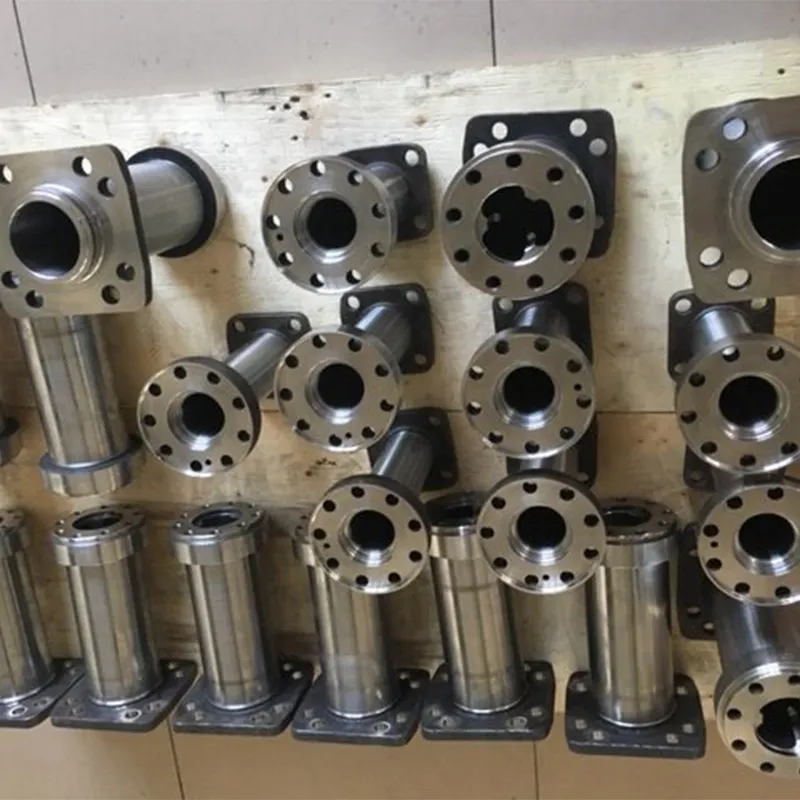
It is commonly specified for components that experience shock load, vibration or occasional overload.Learn more about our ductile iron mechanical parts.
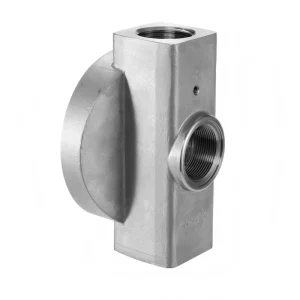
Typical use cases include:
QT400-18 Casting & CNC Machining Notes
Foundry Considerations for QT400-18
Consistent ferrite matrix is the core quality target for QT400-18 production.
Foundry teams focus on two critical control steps: nodularization treatment and inoculation.
Proper inoculation prevents chill formation and stabilizes graphite spheroid shape.
Shrinkage porosity and microshrinkage are common defects for ferritic ductile iron.
Gating and riser systems must be designed to promote directional solidification, especially for heavy-section areas.
Improper cooling will introduce pearlite and reduce elongation below the 18% requirement.
CNC Machining Tips
The soft ferritic microstructure of QT400-18 delivers stable machining performance.
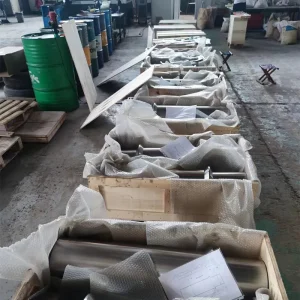
It creates continuous chips instead of abrasive dust, which lowers tool wear compared with harder pearlitic ductile iron.
- Uncoated carbide inserts work well for general turning and milling
- Cutting speed can be set moderately higher than gray cast iron
- Surface treatments such as painting, powder coating or oil impregnation are widely used for corrosion protection after machining
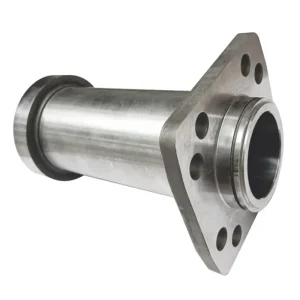
If you are sourcing custom QT400-18 ductile iron castings with CNC finished machining, you can explore our ductile iron casting product range.
QT400-18 vs QT450-10 Ductile Iron
QT400-18 and QT450-10 are two frequently confused GB ductile iron grades.
The table below clarifies their differences for material selection.
| Parameter | QT400-18 | QT450-10 |
| Minimum Tensile Strength | 400 MPa | 450 MPa |
| Minimum Elongation | 18% | 10% |
| Matrix Structure | Fully ferritic | Ferritic-pearlitic |
| Low-Temperature Toughness | Better | Lower |
| Hardness Range | 120–180 HBW | 160–210 HBW |
| Best For | Impact, low-temperature service | Moderate strength, general structural parts |
Choose QT400-18 when elongation and impact absorption are critical.
QT450-10 is preferred for applications requiring higher tensile strength where ductility demands are less strict.
FAQ
Is QT400-18 the same as 60-40-18 ductile iron?
QT400-18 is widely treated as the Chinese equivalent of ASTM A536 60-40-18, yet they are defined under separate standards.
This mapping serves only for preliminary material screening.
All formal acceptance criteria must follow the project’s specified material standard.
Can QT400-18 be welded?
Welding is technically feasible, but it requires careful process control.
Preheating and controlled cooling are mandatory to avoid brittle zones and cracking.
Weld joints will normally lose part of the base material’s ductility.
What is the difference between QT400-18 and QT400-18L?
QT400-18L is the low-temperature variant.
It maintains guaranteed Charpy impact values at lower test temperatures for cold-environment equipment.
Standard QT400-18 only covers room-temperature impact requirements.
Is QT400-18 suitable for wear-resistant parts?
Generally no. Its soft ferritic matrix offers limited abrasion resistance.
For wear applications, higher-hardness ductile iron, austempered ductile iron or alloy cast iron should be considered instead.