If you are sourcing small, complex metal components, you have likely encountered two process names: metal injection molding (MIM) and investment casting. Both promise near-net shapes, both handle intricate geometries, and both are frequently quoted as alternatives for the same part. Yet they are not interchangeable. The choice between them affects tooling investment, achievable tolerances, minimum order quantities, and ultimately the unit cost at your production volume.
This guide breaks down what MIM actually delivers, where it diverges from investment casting, and how to decide which process fits your part—rather than forcing your part into the wrong process.
MIM at a Glance: What the Process Actually Delivers
Metal injection molding belongs to the powder metallurgy family. Fine metal powder is mixed with a polymer binder to create a feedstock, which is then injected into a mold cavity—much like plastic injection molding. The resulting “green” part undergoes debinding to remove the binder, followed by sintering at high temperature. During sintering, the part densifies and shrinks, typically reaching over 95% theoretical density.
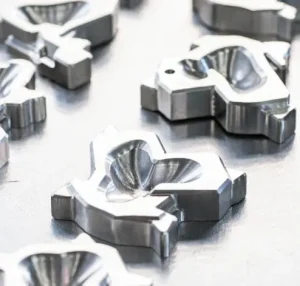
The practical implications of this process define MIM’s capability envelope:
Typical part size. Most MIM parts weigh between 0.1 g and 50 g. Parts up to roughly 200–240 g are possible in practice, though the economic optimum is well below 50 g.
Tolerance. As-sintered tolerances generally fall within ±0.5% of the nominal dimension, though smaller dimensions can achieve tighter absolute tolerances. A representative tolerance guide shows ±0.03 mm for dimensions under 3 mm, scaling to ±0.5% for dimensions above 60 mm. These are typical values; actual capability depends on material, geometry, and tooling.
Minimum wall thickness. MIM can mold walls down to approximately 0.3 mm as a standard design target. Thinner walls may be possible under exceptional conditions and favorable geometries, but 0.3 mm is the practical baseline for production consistency.
Surface finish. Sintered MIM parts typically achieve surface roughness in the range of Ra 0.8–1.6 μm for production parts, with finer finishes achievable under optimized powder and tooling conditions.
Materials. MIM works well with stainless steels, low-alloy steels, titanium alloys, copper alloys, and cobalt-chromium. It is less suited to aluminum and zinc due to oxidation issues during debinding and sintering.
How MIM Compares to Investment Casting: A Dimension-by-Dimension Breakdown
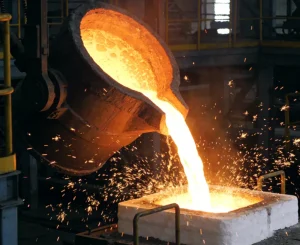
Investment casting—also called lost wax casting—uses a wax pattern coated in ceramic to form a mold, which is then filled with molten metal. The two processes overlap in their ability to produce complex, small-to-medium metal parts, but they diverge on several critical parameters.
Tolerance and Dimensional Consistency
MIM’s as-sintered tolerance of roughly ±0.5% is one of its strongest selling points for small parts. Because the part is molded in a steel cavity and sintered under controlled conditions, dimensional consistency across a production run is generally high.
Tolerance grades for investment casting are typically specified using ISO 8062-3 DCTG grades; achievable grades depend on alloy, shell system, and foundry capability. As a general indication, investment casting tolerances are looser than MIM’s ±0.5% on small features, though they can be adequate for larger dimensions where MIM’s size limitations make it less practical. For parts with critical small features, MIM typically has the edge; for larger parts with moderate tolerance requirements, investment casting is often sufficient.
Minimum Feature Size and Wall Thickness
This is where the two processes differ most visibly. MIM’s powder-binder feedstock flows into fine mold details, enabling walls down to approximately 0.3 mm and small cross-holes, slots, and surface textures that would be difficult or impossible to cast. Investment casting can produce relatively thin walls—typically in the 1.0–1.5 mm range depending on alloy and geometry—but it struggles with the sub-millimeter features that MIM handles routinely. If your design includes thin ribs, fine knurling, or small blind holes, MIM is the more natural fit.
Part Size and Weight
MIM’s economic sweet spot is small parts: under roughly 50 g, and rarely beyond 200 g. Investment casting covers a much broader size range, from a few grams to over 100 kg, though it is most cost-competitive for parts above the size where MIM’s tooling amortization becomes prohibitive. For a 5 g bracket, both processes can quote; for a 500 g housing, investment casting is the practical choice.
Surface Finish
Sintered MIM surfaces are typically smoother than as-cast investment casting surfaces. MIM achieves Ra 0.8–1.6 μm on production parts without secondary operations. Investment casting surface finish depends on the shell system; typical as-cast surfaces are in the Ra 6.3–12.5 μm range, with smoother finishes achievable through process control. Both processes can be polished or machined to finer finishes, but MIM often requires less post-processing for functional surfaces.
Material Flexibility
Investment casting accepts a wider range of alloys because the ceramic mold withstands higher temperatures and does not react with the melt in the same way as MIM’s binder system. Nickel superalloys, cobalt alloys, and aluminum are routinely investment cast. MIM is limited to alloys that can be atomized into fine powder and processed through debinding and sintering without excessive oxidation or residual contamination. Stainless steels and low-alloy steels dominate MIM production; titanium is possible but more demanding; aluminum is generally not suitable.
Mechanical Properties and Density
Sintered MIM parts reach 95–99% theoretical density, with mechanical properties approaching wrought material for many alloys. Investment castings are fully dense in the as-cast condition but may contain shrinkage porosity depending on gating and solidification. The comparison is not a simple ranking: for a given alloy, MIM may offer better fatigue resistance due to finer microstructure, while investment casting may offer better ductility in thick sections. The appropriate comparison depends on the specific alloy and load case.
The Economics: When MIM Makes Financial Sense (and When It Doesn’t)
MIM tooling is expensive. A typical single-cavity or low-cavity mold costs roughly $8,000 to $30,000, rising for complex multi-cavity tooling. That investment must be amortized across production volume. The process typically becomes economically viable at roughly 5,000–10,000 parts per year, with the exact threshold depending on part complexity, material cost, and cavity count.
Investment casting tooling—the wax injection die—is generally less expensive than MIM tooling. This makes investment casting more accessible for lower volumes, prototyping, and designs that may still evolve. Industry experience places the practical crossover in the low thousands to roughly 10,000–15,000 parts per year, below which investment casting is often more cost-effective for comparable parts.
The practical implication for sourcing is straightforward: if your annual requirement is below a few thousand pieces, investment casting is likely the lower-risk financial choice. If you expect steady volume above roughly 5,000–10,000 units and your part fits MIM’s size and feature envelope, the higher tooling investment can pay back through lower unit costs and reduced secondary machining.
Suitable and Unsuitable Scenarios: A Practical Decision Guide
Rather than declaring one process superior, the useful question is: which process matches this part, at this volume, with these requirements?
Lean toward MIM when:
- The part weighs under ~50 g and fits in the palm of your hand.
- The geometry includes thin walls (approaching 0.3 mm), fine surface detail, or small cross-features.
- Annual volume is at or above roughly 5,000–10,000 pieces.
- The alloy is a stainless steel, low-alloy steel, or titanium that is well-established in MIM feedstock supply.
- Tolerance requirements are tight enough that investment casting would require significant secondary machining.
Lean toward investment casting when:
- The part is larger or heavier than MIM’s economic range.
- Annual volume is low (prototype through low-thousands).
- The alloy is a nickel superalloy, aluminum, or another material not well-suited to MIM feedstock.
- The design is still evolving and you want to avoid committing to expensive MIM tooling.
- Tolerance requirements are moderate and achievable with as-cast dimensions plus selective machining.
Both may be viable when:
- The part is small but not extremely complex, and volume sits in the 5,000–15,000 range.
- The alloy is common to both processes (e.g., 17-4PH stainless steel).
- In these cases, requesting quotes from suppliers who offer both processes is the most reliable way to compare real costs, rather than relying on general rules of thumb.
Frequently Asked Questions
Can MIM replace investment casting for my part?
It depends on size, volume, and feature detail. MIM excels at small, complex parts in high volumes. If your part is under ~50 g, requires fine features, and you need thousands of units annually, MIM is a strong candidate. If the part is larger or your volume is lower, investment casting may remain more practical.
What is the minimum order quantity for MIM compared to investment casting?
MIM is not typically quoted below a few thousand pieces because tooling costs dominate; below that threshold, tooling amortization makes the per-part price uncompetitive against casting or machining. Investment casting can be economical at much lower volumes, including prototypes and small production runs.
Which process achieves tighter tolerances?
For small dimensions, MIM generally holds tighter as-sintered tolerances (±0.5% typical, with tighter absolute values on small features). Investment casting tolerances are looser on small features but can be adequate for larger dimensions where MIM is not size-appropriate.
Can MIM parts be heat treated or machined after sintering?
Yes. Sintered MIM parts can be heat treated, machined, polished, and coated using standard processes. In many cases, MIM reduces the amount of machining required compared to casting, but secondary operations remain possible where needed.
What materials are difficult or impossible for MIM?
Aluminum and zinc are generally unsuitable due to oxidation and binder interaction issues. High-melting-point superalloys may be technically possible but are less common. Investment casting covers a broader alloy range overall.
Conclusion: Matching the Process to the Part
MIM and investment casting are not competitors in a winner-take-all sense. They occupy different regions of the size–volume–complexity space. MIM delivers exceptional precision and feature detail for small parts at high volumes, but demands tooling investment that only makes sense when production volume justifies it. Investment casting offers broader material flexibility and lower tooling barriers, at the cost of looser tolerances and less capability for sub-millimeter features.
The most reliable path forward is to evaluate your specific part against these dimensions—size, feature detail, alloy, tolerance, and annual volume—and then request process-specific quotes from suppliers who can demonstrate experience with both. Provide the same drawing and volume forecast to each quote, and ask the supplier to flag any design features that fall outside their normal capability. A part that looks like a perfect MIM candidate on paper may reveal tooling or material constraints in practice; likewise, an investment casting quote may surprise you on tolerance capability. Let the part and the production reality decide.











