Summary: A technical guide to Inconel 718 investment casting challenges, including hot cracking and machining, and what buyers should check in a supplier.
Inconel 718 is one of the most widely used nickel-based superalloys. It maintains high strength, creep resistance, and fatigue life at temperatures up to roughly 700°C.
These properties make it a standard choice for aerospace engine components, gas turbines, and oil and gas equipment.
However, the same characteristics that make Inconel 718 desirable also make it notoriously difficult to cast and machine.
When sourcing Inconel 718 investment casting components, buyers often find that not every foundry can deliver sound castings.
Understanding the metallurgical roots of these difficulties is more useful than simply requesting a list of certifications.
Certifications show that a facility passed an audit, not that its process control is capable of managing this specific alloy.
Why Inconel 718 Is Challenging for Investment Casting
Investment casting is well-suited to Inconel 718 because it can produce complex, near-net shapes and reduce the amount of expensive superalloy removed by machining.
But the solidification process inherent to casting introduces two primary defect risks.
The Risk of Hot Cracking (Laves Phase)
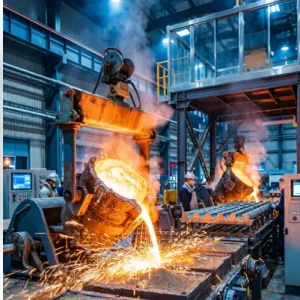
Inconel 718 contains niobium (Nb). During the final stages of solidification, the residual liquid becomes enriched in Nb, silicon, and other elements, promoting the formation of Laves phase.
Research indicates that even residual Laves phase levels as low as 0.14–0.35 wt% can be detrimental to hot ductility and stress rupture properties.
The presence of Laves phase extends the effective freezing range, leaving the interdendritic regions without sufficient ductility to accommodate contraction strains late in solidification.
Under thermally strained conditions, this leads to hot tearing.
Cooling rate is the primary variable for controlling Laves phase. Slower cooling allows more niobium segregation and increases the likelihood of retaining residual Laves phase at room temperature; faster cooling can partially suppress its formation.
Consequently, a foundry’s ability to control shell preheat temperature, pouring temperature, and cooling schedules directly dictates its success in preventing hot cracks.
Shrinkage and Internal Porosity
The shrinkage behavior of Inconel 718 is highly sensitive to the process window. Simulation studies on turbine blade castings show that when mold dwell time increases from 0 s to 420 s, shell temperature drops from 1000°C to 860°C, and total shrinkage volume and frequency increase correspondingly.
This means that if thermal management before pouring deviates from the designed window, internal porosity will increase significantly.
Internal porosity in Inconel 718 castings is not a rare anomaly but a typical failure mode resulting from inadequate process control.
For load-bearing or fatigue-critical parts, even after Hot Isostatic Pressing (HIP), micro-shrinkage can still shorten fatigue life.
Therefore, shrinkage risk must be addressed from the gating system design and solidification simulation stages.
Post-Casting Challenges: Machining Inconel 718
Even a sound casting still presents significant machining difficulties. Inconel 718 has low thermal conductivity, concentrating cutting heat near the tool edge, while its austenitic structure causes rapid work hardening under cutting stress.
This work-hardened layer accelerates flank wear, creating a cycle where cutting makes the material harder, which in turn wears the tool faster.
For cutting parameters, uncoated carbide tools perform well in the 10–30 m/min range; for speeds above 40 m/min, coated carbide inserts are more suitable.
This speed range is significantly lower than conventional parameters for aluminum or standard steel, meaning machining time and tooling costs for Inconel 718 are inherently higher.
From a procurement perspective, this raises a critical supplier evaluation point: foundries with in-house machining capabilities typically have an advantage over those that only cast and outsource machining.
Inconel 718’s work-hardening behavior demands coordinated optimization of cutting parameters, tool paths, and fixture rigidity.
If the foundry controls both casting tolerances and machining allowances, it can specify more appropriate conditions during casting, reducing the risk of abnormal tool wear or surface integrity damage caused by improper allowances.
How to Evaluate an Inconel 718 Foundry
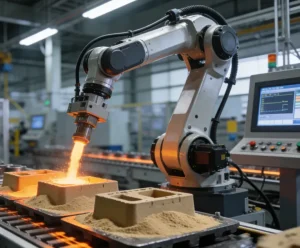
When evaluating suppliers for Inconel 718 castings, certifications are a threshold, not a sufficient condition.
The following capabilities are more indicative of whether a facility truly controls this alloy.
1. Melting and Pouring Atmosphere Control. Inconel 718 is sensitive to oxygen, nitrogen, and hydrogen, requiring appropriate protection during melting and pouring.
Vacuum Induction Melting (VIM) can limit oxidation and gas pickup where applicable, but not all Inconel 718 castings require VIM. The process route must be confirmed against part specifications and applicable standards.
2. Heat Treatment Control. The as-cast hardness of Inconel 718 does not represent final service performance.
The commonly specified heat treatment route in industry literature consists of solution treatment at approximately 980°C followed by rapid cooling, a first aging at 720°C for 8 hours, furnace cooling to 620°C for a second 8-hour aging, and air cooling.
This two-stage aging precipitates the γ″ strengthening phase responsible for the alloy’s strength.
If the supplier lacks controlled furnaces and traceable temperature curves, the casting may meet metallurgical quality standards but fail mechanical property requirements.
3. Scope of Non-Destructive Testing (NDT). The internal shrinkage and hot cracking tendencies of Inconel 718 mean NDT cannot rely on visual inspection alone.
X-ray radiography detects internal shrinkage and cracks, fluorescent penetrant inspection (FPI) identifies surface-breaking defects, and ultrasonic testing may supplement near-surface or internal evaluation.
Confirm whether NDT is performed in-house or outsourced, and whether acceptance criteria match the part’s application.
4. Material Traceability and Batch Consistency. The chemical composition of each Inconel 718 heat—particularly Nb, Si, and C levels—and its cooling history influence Laves phase formation tendency.
Requiring heat-number-level melting records, heat treatment logs, and NDT reports is a direct way to assess whether the supplier’s process control is systematic.
5. Casting-to-Machining Integration. As noted, Inconel 718’s work hardening makes the interface between casting and machining critical.
If the supplier can manage the entire workflow in-house, the coordination of tolerance allocation, allowance design, and defect remediation strategies is typically more efficient.
For examples of machining capabilities for complex alloys, you can review our capabilities.
Application-Specific Considerations
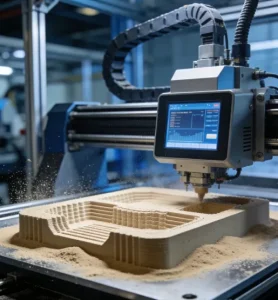
Inconel 718 investment casting typically falls into two application categories.
Aerospace engine and gas turbine hot-section structural components (such as casings, mounting flanges, and brackets) require high-cycle fatigue performance, with very low tolerance for internal porosity and surface integrity issues.
Oil, gas, and energy equipment components like valve bodies, pump parts, and wellhead components focus more on corrosion resistance and pressure integrity, where the defect tolerance window for hot-crack-sensitive but non-fatigue-critical parts may be relatively wider.
This does not mean one application is “easier” to cast. It means the supplier evaluation emphasis should shift with the part’s end use.
A foundry with a consistent delivery record on non-critical structural castings may not possess the process control and documentation system required for aerospace-grade Inconel 718 castings.
Clarifying the part’s final application and applicable standards during the RFQ stage helps the supplier determine whether its process capabilities match, avoiding the discovery of mismatched acceptance criteria only after a quality dispute arises.











