Shell mold casting occupies a practical middle ground that engineers and buyers often overlook. It delivers better dimensional accuracy and surface finish than ordinary sand casting, but it does not carry the tooling cost or lead time of investment casting. For parts with moderate complexity and a tolerance requirement that is demanding but not extreme, this process can be the most economical route to a reliable casting.
This article explains how the resin-coated sand process works, where its accuracy boundaries lie, and how to decide whether to specify shell mold casting or lost wax casting for a given part. The goal is not to promote one process over the other, but to give you the criteria to make that call with confidence.
What Is Shell Mold Casting and How Does the Resin-Coated Sand Process Work?
Shell mold casting, sometimes written as shell moulding casting, is an expendable mold process that uses resin-coated sand to form a thin, rigid shell around a heated metal pattern. Molten metal is then poured into the assembled shell by gravity. The resin binder is what separates this process from conventional sand casting: it gives the sand mold enough strength to hold its shape precisely during pouring, so the mold cavity does not deform or erode as easily.
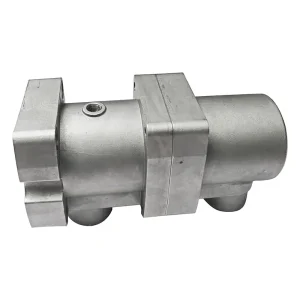
The basic sequence is straightforward. A metal pattern, typically iron or steel, is heated and coated with a release agent. Resin-coated sand is dropped or blown onto the hot pattern, where the heat partially cures the resin and forms a shell of controlled thickness. The pattern and shell are then heated further to complete the cure, and the shell is stripped from the pattern. Two shell halves are clamped or glued together, cores are inserted if needed, and the assembly is supported in a flask before pouring.
At Qingdao Qiangsenyuan, shell mold casting uses resin-coated sand gravity casting for gray iron and ductile iron parts, including mechanical structural components and pump and valve housings. The process suits production runs of castings that require better quality and precision than ordinary sand casting can deliver.
The key advantage of the resin-coated sand system is dimensional stability. Once the shell is cured and stripped, it does not deform before pouring. That stability is the foundation for the tolerance and surface finish numbers discussed in the next section.
Tolerance and Surface Finish Boundaries: What Shell Mold Casting Can and Cannot Deliver
The practical accuracy envelope for shell mold casting at Qingdao Qiangsenyuan is defined by three figures: dimensional tolerance CT7–9, surface roughness Ra 12.5–25μm, and minimum wall thickness 3mm. These are the numbers to use when evaluating whether a part is a candidate for this process.
CT7–9 is a meaningful step above ordinary sand casting. For a 100mm dimension, this grade corresponds to a tolerance band in the range of roughly ±0.5 to ±1.0mm, depending on the specific size segment and alloy; the exact values depend on the applicable tolerance standard for that dimension range. That is tight enough for many machined mating surfaces to be finished with a single pass, and tight enough for non-mating features to remain as-cast. Ra 12.5–25μm produces a surface that is visibly smoother than raw sand casting and reduces the amount of cleaning and surface preparation required before painting or assembly.
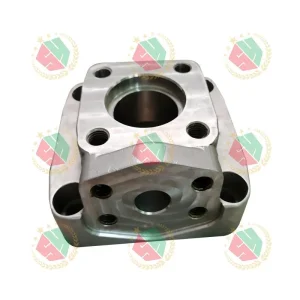
The 3mm minimum wall thickness is a useful screening criterion. Parts with thinner walls or very fine detail may not fill reliably in shell mold casting, and the risk of misruns increases as wall thickness drops.
What shell mold casting does not deliver is investment-casting-grade precision. Lost wax casting can achieve finer surface finishes and thinner walls than the figures above. That gap is real, and it is the reason the selection decision in the next sections is not automatic. Shell mold casting is the better choice when CT7–9 and Ra 12.5–25μm are acceptable. It is the wrong choice when they are not.
One further note on scope: the published capability at Qingdao Qiangsenyuan covers gray iron and ductile iron. If your part requires cast steel, confirm material availability before proceeding, because the process literature describes steel as compatible with shell molding in general, but the specific production scope should be verified with the supplier.
What Parts Suit Shell Mold Casting?
Medium-Complexity Geometry and Batch Production
Shell mold casting is at its best when a part has enough complexity to rule out simple sand casting, but not so much complexity that investment casting becomes the only viable route. Internal cavities, fine grooves, and protrusions are all within reach, provided the wall thickness stays at or above the 3mm threshold. Mechanical structural parts, pump bodies, and valve housings are representative examples of the kind of geometry that fits well.
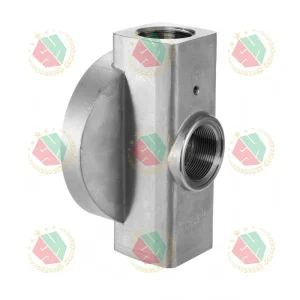
The batch dimension matters just as much as the geometry. Shell mold casting requires a metal pattern, which carries a one-time cost. That cost is lower than the tooling required for lost wax casting, but it still needs to be absorbed across a production run. If the order quantity is very small, the per-part pattern cost can undermine the economics of the process. If the quantity is substantial and the tolerance requirement sits within CT7–9, shell mold casting is often the more cost-effective path.
A practical self-check for engineers and buyers: does the part have non-mating surfaces that need to look clean without extensive finishing? Will the same part be ordered repeatedly? Is the tolerance requirement demanding but not investment-casting demanding? If the answer to all three is yes, shell mold casting deserves serious consideration.
Shell Mold Casting vs. Lost Wax Casting: Precision, Cost, and Volume Trade-offs
The trade-off between shell mold casting and lost wax casting comes down to three variables: precision, pattern cost, and production volume.
On precision, lost wax casting wins. It produces finer surface detail and can handle thinner walls. Shell mold casting does not match that, but it does not need to for a large share of industrial parts. The CT7–9 and Ra 12.5–25μm window is sufficient for many pump, valve, and structural applications.
On pattern cost, shell mold casting has the advantage. The metal pattern used in shell molding is less expensive to produce than the wax injection tooling and multi-layer shell system required for investment casting. This cost difference is qualitative and depends on part geometry, but the direction is consistent: shell mold tooling is the lighter investment.
On production volume, the economics shift. At low volumes, the lower pattern cost of shell mold casting helps, but the per-part cost of the process may still be higher than expected if the order cannot amortize the pattern. At medium to high volumes, shell mold casting becomes increasingly efficient because the reusable pattern supports repeated shell production. Lost wax casting remains competitive at low volumes when precision requirements are extreme, because in those cases the higher tooling cost is justified by the part’s functional requirements.
For a steel casting part, the same logic applies, but material confirmation is essential before committing to the process. For shell molding cast iron parts, the fit is more direct, given the published production scope.
When to Specify Shell Mold Casting Instead of Lost Wax Casting: A Decision Guide
Use the following table as a screening tool, not as a substitute for a drawing review with your supplier.
| Decision Factor |
Lean Toward Shell Mold Casting |
Lean Toward Lost Wax Casting |
| Tolerance requirement |
CT7–9 acceptable |
Better than CT7 required |
| Surface finish requirement |
Ra 12.5–25μm acceptable |
Finer than Ra 12.5 required |
| Wall thickness |
3mm or greater |
Thinner than 3mm, or very fine detail |
| Production volume |
Medium to high, pattern can be amortized |
Low volume, or precision justifies tooling cost |
| Pattern cost sensitivity |
Lower tooling budget preferred |
Tooling investment justified by performance |
The logic behind the table is simple. If the part’s functional requirements fall inside the shell mold casting capability window, specifying lost wax casting adds cost without adding value. If the part’s requirements fall outside that window, specifying shell mold casting creates risk. The decision should be driven by the drawing, not by a default preference for either process.
Procurement Checklist for Shell Mold Casting Parts
Once the process decision is made, the procurement conversation should focus on the details that determine whether the delivered castings match the drawing and the expected cost.
- Drawing and tooling review. Confirm that the supplier will design the gating and riser system, core layout, and cavity count based on your 3D drawing and material specification. The pattern design directly affects yield and casting soundness, so this step should not be rushed.
- Material verification. Ask whether the supplier performs spectral analysis on incoming raw material and on the poured metal. At Qingdao Qiangsenyuan, spectral analysis is part of the standard process to confirm composition. For gray iron and ductile iron, this is a basic but important check.
- First-article inspection. Before mass production, the supplier should cast a small number of samples and test appearance, dimensions, and mechanical properties. Review this report against the drawing before approving the run.
- Pattern ownership and lifespan. Clarify the pattern fee structure and what happens when the pattern reaches the end of its life. The published policy at Qingdao Qiangsenyuan is a one-time mold fee per part, with a free replacement pattern after the original reaches its lifespan. Confirm that this applies to your specific part.
- Machining boundary. Decide whether you are purchasing as-cast parts or finished parts, and specify the machining standard accordingly. If finishing is required, the drawing should indicate which surfaces are machined and to what tolerance.
- Volume and lead time. Confirm the minimum order quantity and expected production lead time for your part. These depend on pattern readiness, material availability, and current shop load, so they are best discussed as part of the quotation rather than assumed from a general capability statement.
One note on scope: this checklist focuses on the technical confirmation specific to shell mold casting. Broader supplier evaluation criteria, such as quality management systems or audit history, are a separate topic.
FAQ
What tolerance can shell mold casting hold?
CT7–9 is the published capability for the process at Qingdao Qiangsenyuan. The exact tolerance for a given dimension depends on the size segment, alloy, and pattern design, so the drawing should be reviewed with the supplier rather than judged against a single number.
Can shell mold casting replace lost wax casting?
For some parts, yes. If the tolerance requirement is CT7–9 or looser, the surface finish requirement is Ra 12.5–25μm or rougher, and the production volume is sufficient to amortize the pattern, shell mold casting is often the more economical choice. It is not a replacement when the part requires finer precision or thinner walls than the shell mold process can deliver.
What materials are suitable for shell mold casting?
At Qingdao Qiangsenyuan, the process is used primarily for gray iron and ductile iron parts. Shell molding as a process is compatible with other ferrous and non-ferrous metals, but material availability should be confirmed with the supplier for your specific application.
How does pattern cost affect the choice between shell molding and investment casting?
Shell mold patterns are generally less expensive than investment casting tooling. That lower tooling cost improves the economics of shell mold casting for medium and high volumes. At very low volumes, the pattern cost still needs to be absorbed, and the advantage narrows. The comparison is qualitative and should be evaluated against your specific order quantity and part geometry.
Next Step
If you are evaluating a part for shell mold casting, the most useful next step is a drawing review. Qingdao Qiangsenyuan’s shell mold gravity casting service covers gray iron and ductile iron parts, with published tolerances of CT7–9 and surface roughness of Ra 12.5–25μm. You can review the process details at Shell Mold Gravity Casting and submit a drawing for an assessment of whether the part fits the process window.











