Summary: A practical comparison of Stellite 6 and Stellite 21, explaining how carbon content and tungsten-versus-molybdenum drive the hardness and toughness trade-off.
Stellite 6 and Stellite 21 are the two cobalt-based wear alloys most often compared against each other. A common default is to specify Stellite 6 whenever there is uncertainty. That habit has a reasonable basis: Stellite 6 has a long application history, well-documented behavior, and mature processing experience. But in two situations the default can introduce unnecessary risk: when the part sees rapid thermal cycling or thermal shock, and when the part has thin walls or abrupt section changes.
Stellite 21 exists largely to address the toughness limitation of Stellite 6 in those conditions. Understanding the trade-off between the two is more useful than memorizing which one is “better.”
Composition differences drive the performance split
The performance gap between these alloys comes down to two compositional choices.
Carbon content. Stellite 6 carries a significantly higher carbon level. Under SAE AMS 5387, Stellite 6 castings have a nominal composition of 60Co-29Cr-4.5W, with carbon typically in the 0.9–1.4% range for cast products. More carbon means more hard carbide precipitation, which directly raises hardness and wear resistance. Stellite 21 has much lower carbon, with a nominal composition of roughly C ~0.25%, Cr 25–30%, Mo 4.5–6.5%, Ni 1.5–3.5%, balance Co. Lower carbon means a lower carbide volume fraction and a microstructure dominated by the cobalt solid-solution matrix.
Tungsten versus molybdenum. Stellite 6 uses tungsten (W) as its main solid-solution strengthener; Stellite 21 replaces most of that tungsten with molybdenum (Mo). Molybdenum has roughly half the atomic weight of tungsten, so at the same weight percentage it contributes about twice as many atoms. Molybdenum also has a stronger affinity for carbon and tends to promote carbide formation. In Stellite 21, however, the low carbon level limits that effect, and the net result is a substantially lower total carbide content than Stellite 6.
Together, these two differences produce two distinct performance profiles.
Stellite 6: carbide density in exchange for wear resistance
The microstructure of Stellite 6 consists of a cobalt-based solid-solution matrix with a relatively dense distribution of hard carbide particles. This structure performs well under abrasive wear.
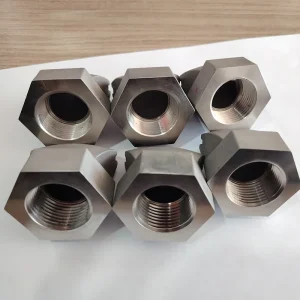
Where it fits. Valve sealing faces, pump sleeves, slurry handling components, and general wear parts under moderate impact are typical Stellite 6 applications. Its hardness usually falls in the Rockwell C 37–45 range, depending on casting condition and subsequent heat treatment, which is sufficient for most abrasive wear problems. In oxidizing high-temperature environments, Stellite 6 also forms a protective oxide layer based mainly on Cr₂O₃ and CoCr₂O₄, with a lower oxidation rate than Stellite 21.
Where the limits show up. The carbide density has a side effect: under rapid thermal cycling or localized thermal shock, the thermal expansion difference between carbides and matrix can become a crack initiation site. For thin-section parts, the higher carbon and carbide content can also raise the risk of cracking during casting and machining. This does not mean Stellite 6 cannot be used in these situations, but when thermal fatigue is the dominant failure mode, an alternative should be seriously evaluated.
Stellite 21: lower carbide content in exchange for toughness and thermal fatigue resistance
Stellite 21 follows a different design logic. Its low carbon content and molybdenum addition sharply reduce the carbide volume fraction, leaving the cobalt solid-solution matrix as the phase that carries mechanical performance.
The direct consequence: room-temperature hardness and pure abrasive wear resistance are lower than Stellite 6, but toughness, thermal shock resistance, and thermal fatigue resistance are better. As-cast hardness is typically reported in the low-to-mid HRC 30s, below that of Stellite 6 (exact values depend on product form and test condition — verify against supplier data before specifying). Its advantage is not out-wearing abrasives but maintaining structural integrity under thermal cycling.
Where it fits. Stellite 21 has been used in gas turbine blades, hot-working valves, high-temperature fasteners, and weld overlays that need to buffer thermal expansion mismatch. Where Stellite 6 serves as a top layer and an intermediate layer is needed, Stellite 21 has historically been used as a buffer to soften the thermal expansion difference between the steel substrate and the Stellite 6 top layer. A study on F91 steel substrates with Stellite 21 buffer layers, aged at 550–650°C for up to 8,760 hours, found significant impact toughness loss at the F91/S21 interface, which is why nickel-based buffer layers are increasingly preferred in that specific application. This illustrates the alloy’s position well: its value lies in toughness under specific conditions, not in replacing Stellite 6 everywhere.
An easily overlooked limitation. Stellite 21 has relatively limited resistance to hard-particle erosion. Because carbide density is low, the matrix offers less protection when sharp particles strike at speed. Under low-angle erosion and hard abrasive wear, Stellite 21 is usually not the best choice.
A practical selection path
The following path is based on the performance characteristics of the two alloys. It can serve as an initial screening guide but should not replace an engineering assessment of the specific application.
Lean toward Stellite 6 when:
- The dominant failure mode is abrasive or adhesive wear, and thermal cycling is not a major load.
- The part has a thick section, and cracking sensitivity during casting and machining is manageable.
- Service temperature is high in an oxidizing atmosphere, and a protective oxide layer is part of the design.
- The application has an established Stellite 6 history with failure data to reference.
Lean toward Stellite 21 when:
- The part undergoes repeated rapid heating and cooling, and thermal fatigue cracking is a known risk.
- The part has thin walls or abrupt section changes, and toughness matters more than raw hardness.
- A transition layer is needed between a steel substrate and a hard facing to buffer thermal expansion mismatch (but long-term high-temperature stability must be evaluated).
- The wear mechanism is mainly metal-to-metal sliding wear or cavitation rather than hard-particle erosion.
When neither is a clean fit: If the application demands both high abrasive wear resistance and excellent thermal fatigue resistance, Stellite 12 (higher carbon, higher wear resistance) or the Tribaloy family of intermetallic-strengthened alloys may be worth considering, or the part’s thermal management may need to be addressed at the design level. These directions go beyond this comparison but belong in an early-stage material selection review.
What to include in an RFQ
Whichever alloy is selected, a casting and machining supplier usually needs the following before it can give a meaningful quote:
- Part drawings with key dimensions and tolerance requirements.
- Service conditions: temperature range, medium, and load type (wear, impact, thermal cycling).
- Expected life or known failure mode, with a historical part if available.
- Material standard, for example whether AMS 5387 or another applicable specification must be met.
- Quantity, since single pieces, small batches, and production volumes lead to different process choices.
For cobalt-based alloy castings, it is also worth confirming whether the supplier has in-house capability from casting through finish machining, because these alloys work-harden noticeably and the handoff between processes affects both cost and lead time.